Big tents: Can we let liberals into the movement for liberation?

Liberals—defined as people with progressive social beliefs who generally support capitalism implicitly because they don’t know what it is or because they have a poor understanding of it, ie. those who believe “sexism and homophobia are bad but land ownership is good”—are not going to save us. No movement against fascism will ever succeed if it’s not led by the left, because fascism is capitalism in crisis. Yes, it is our job on the left to help people see this. No, we cannot sit back and let liberals call the shots.

But, can we let liberals into the movement for liberation? The question itself, though I see it discussed a lot, is misleading: in the end, no one is in charge. There’s no lineup with a broad-chested trans masc аntifа supersoldier holding a velvet rope making sure no one who’s ever said “well people taking advantage of welfare is a problem” gets in (believe me, I wish it were that easy). This is a decentralized, often organic movement. Libs are finding their way into it by being radicalized by what they’re seeing in their communities, thanks to the repulsive buffoons that run the American Gеstapο. And that’s great! That’s what we want! We should be excited by all the newly energized soccer moms and Formula 1 dads taking to the streets. But wait… They’re bringing with them some beliefs and practices that are counterproductive to the fight for liberation. Some have questions about trans women in sports, some believe that certain settler colonies have a right to exist. Not great! But also, inevitable, because we were all raised in a shitty, settler colonial system that kept us hidden from the truth of our interconnectedness at all costs.

The tent should be big. It has to be, in order to build enough working class power to challenge capitalism. But we must use this big tent to shelter people while we help them see that all our struggles are connected. Liberalism cannot be anything more than a temporary stepping stone that people go through in their journey towards anti-capitalism, guided by those who understand class, race, gender, and other intersections of oppression.

There are many critiques of the rigid purity politics on the left, where we put extremely strict ideological demands on others in order to be willing to work with them, and are quick to label anyone who doesn’t live up to our standards as problematic, sexist, racist etc, and thus not welcome in our revolution. Some of those critiques are in bad faith, coming from loud centrist political pundits who actually just want to browbeat the left into submission to make us vote for capitalist political candidates who will perform civility and throw our most vulnerable neighbours under the bus to hold onto the crumbling fantasy of peace that our white supremacist nations are built on. However, just because some of the critiques are in bad faith does not make it a non-issue. Demanding ideological purity is a problem on the left. And it’s because we don’t want to take on the responsibility of teaching and helping propagandized but well-meaning people. It’s hard and we’re tired, so instead we want people to show up already educated. That’s not a path to winning.

We don’t have enough conversations about who is going to take on the work of deprogramming well-meaning working class people who’ve been conned into prejudice. We don’t even like to admit that that work is necessary, because it’s scary to confront how complex and imperfect your average fellow human is. People can be really kind, and believe in the value and dignity of other humans, and also believe that “if you work hard you’ll succeed” or “things were fine before Тrump, he’s the problem,” both obviously false statements. Very few people are actually fixed in their beliefs and committed to their bigotry, but since that category of people provides an easy out from doing the work of helping them, we broadly lump everyone who’s remotely frustrating into that category, call it a day, and go rot in doomerism.

I do understand why people respond to those Big Tent “purity politics” critiques with “oh so you want us to let racists/transphobes into the movement,” because for a lot of liberal pundits who specialize in punching left, that essentially is what they want. They want to think of themselves as progressive, they want to be seen as one of the cool kids who’s against the status quo, but they also want to keep their cushy positions within the status quo. They want to have their cake and eat it too. They don’t understand that the climate crisis is coming for all of us, and they are stuck in a constructed reality of denial where they believe America, or Canada, or England, or wherever state they’re from that’s built on a foundation of genocide and upheld by militarized borders and imperialism abroad, is fundamentally good and all we need is the right people at the top of this house of cards and we can all go back to brunch. They don’t realize that the only reason they have positions of influence at all is that they’re useful idiots for the people in power.

So fuck that, obviously. But at the same time, when we zoom out on the purity politics issue and stop using labels as a way to dehumanize people… A broad working class movement is going to necessarily include people who haven’t deprogrammed all their prejudices.

You and I haven’t deprogrammed all of ours! How can we expect more of others than ourselves?

You likely have some fatphobia rattling around in there. Maybe some drug user stigma, some sanism, prejudice against children, probably lots of ableism. Almost certainly, unless you’re Indigenous or have been working HARD at decolonizing, you’ve got anthropocentrism.

You’re also still whole and valued. You are as essential to the movement for liberation as every other working class person. You’re a good person who cares, who was harmed and misled by the systems that hid these issues and others’ experiences from you. Just like the Resist lib who reveres the founding fathers or thinks we need cοps.

As someone who has been working for nearly two decades on building coalitions among different liberation-minded groups, and who wrote my PhD dissertation on this exact topic, it always feels very ironic and frustrating to see the impatience leftists have for some forms of ignorance and prejudice, while openly displaying others themselves. Sometimes literally at the same time! “That politician must be crazy/smoking crack.” “Put that person in prison for life!” Like, come on man, you’re killing me here.

But I understand that people are always doing their best, and the propaganda system is more well-funded than we can even imagine. That’s how good people are at heart and how oriented we naturally are towards each other; it takes billions of dollars and a vast, massive system to try to convince us otherwise, and it still hasn’t fully worked!

So we could all benefit from practicing way, way more humility and grace in movement-building work, and seeing others as propagandized and in need of guidance, rather than bad and deserving punishment/ostracism. If they mean well, help them do better.

Also, it’s highkey super useful to have pussy hat libs walking around calling themselves antifa. It takes the heat off of us! We need them muddying the waters of who the target for suppression should be!

So, what can we do?

If you do feel ready to do this deep, difficult, rewarding work of movement-building, here are my suggestions. But first, I want to express my gratitude to you, because it’s honestly REALLY fucking hard to push past the anger enough to do this. Most people are not resourced enough for it. I struggle with it all the time!

Identify which of your identities makes you best suited to talk to other people with that same identity. As much as it sucks, I have to talk to white people because they are more likely to listen to me than the Black and Indigenous people I have learned from. It’s a responsibility, but also an opportunity. Men, talk to other men. Straight people, talk to other heteros. Religious people, talk to others in your faith. Non-Indigenous people, talk to other settlers. Most of all, working class people, talk to each other about class issues! (Class is generally the most productive place to focus your efforts in my opinion, because it’s the great uniter, and the reason we were divided against each other by capitalists in the first place.)

Here are five resources I suggest to start with to build these communication and organizing skills. None are perfect, all are just tools in a toolbox. Pick whichever interests you, leave anything you don’t feel aligned with.

1) Nonviolent communication training: an incredibly resource for learning how to talk to and connect with people using a non-authoritarian approach. (This is where I learned to identify how often people interpret suggestions and requests as demands, a quick way to see how unresolved trauma functions to hamstring our movements.)

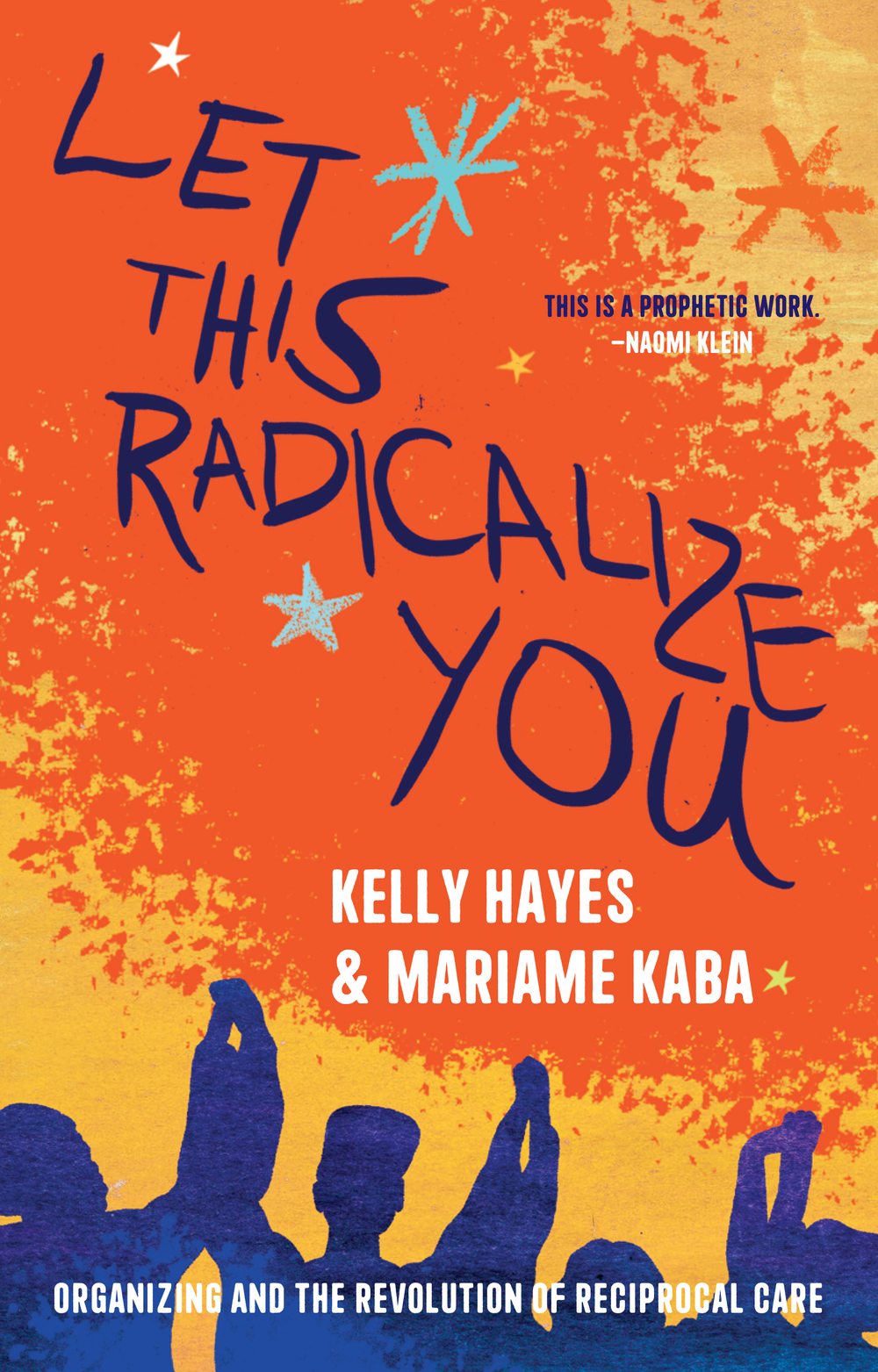
2) Let This Radicalize You by Kelly Hayes and Mariame Kaba: practical advice for organizing and activism, and how to make hope something that you build with others.

3) Maybe I’m cheating by calling this one a single resource, but it’s just too good! Interrupting Criminalization has got so much! Use it all, share it all! They are amazing!

4) Shaun does amazing work speaking to and about young white men from a critical but also humanizing perspective. Here’s another of his videos, and more resources I’ve compiled for fostering positive masculinity.

5) This one is a bit of a spicier recommendation, but if you’re ready to go even deeper and see how spirituality is an essential component we need to integrate in order to combat the appeal of fundamentalist cults, then listen to The Emerald podcast. “Oh Justice” is a relevant episode, but listen to any that pique your interest. My favourite is “Snail Juice.”

Be well, keep up the good work, rest and find joy. I love you, we’re all in this together.

Hi, I quit academia to educate without gatekeeping. It makes me very little money, but if I get enough supporters, I can do it full time. If you appreciate this article, please share it with others! Here are three ways to say thank you, and support me doing more of it:

❤️ Join my Patreon 

💲 Send me some cash I can use to pay rent

👧 Buy my kids supplies like toothpaste and sunscreen!

Dr. Hilary Agro is an anthropologist, community organizer and mother of two young children.

Can people with bad political beliefs change?

“They should know better.”

Well, they don’t. What now?

I see a lot of rhetoric these days about how certain people in certain political cults–oh, you know the ones–are beyond saving. This is often applied extremely broadly, to anyone who has voted a certain way or espoused certain beliefs, even if they also hold other contradictory beliefs (which, like it or not, most people do). They’re lumped together and called “they” with no room for complexity or exceptions. They are like this, they are like that, they won’t listen, they are bad people.

When we say that people can’t change, that is not leftism. It implies one of two things: 1) a carceral approach, or 2) a doomerist approach. Because it essentially means either 1) we have to lock those people up (or worse) because they’re unfixable–ironically, the exact same authoritarian dehumanizing rhetoric They use about Us, except it’s fine because we’re good and correct. Or 2) there’s nothing we can do and we should just give up.

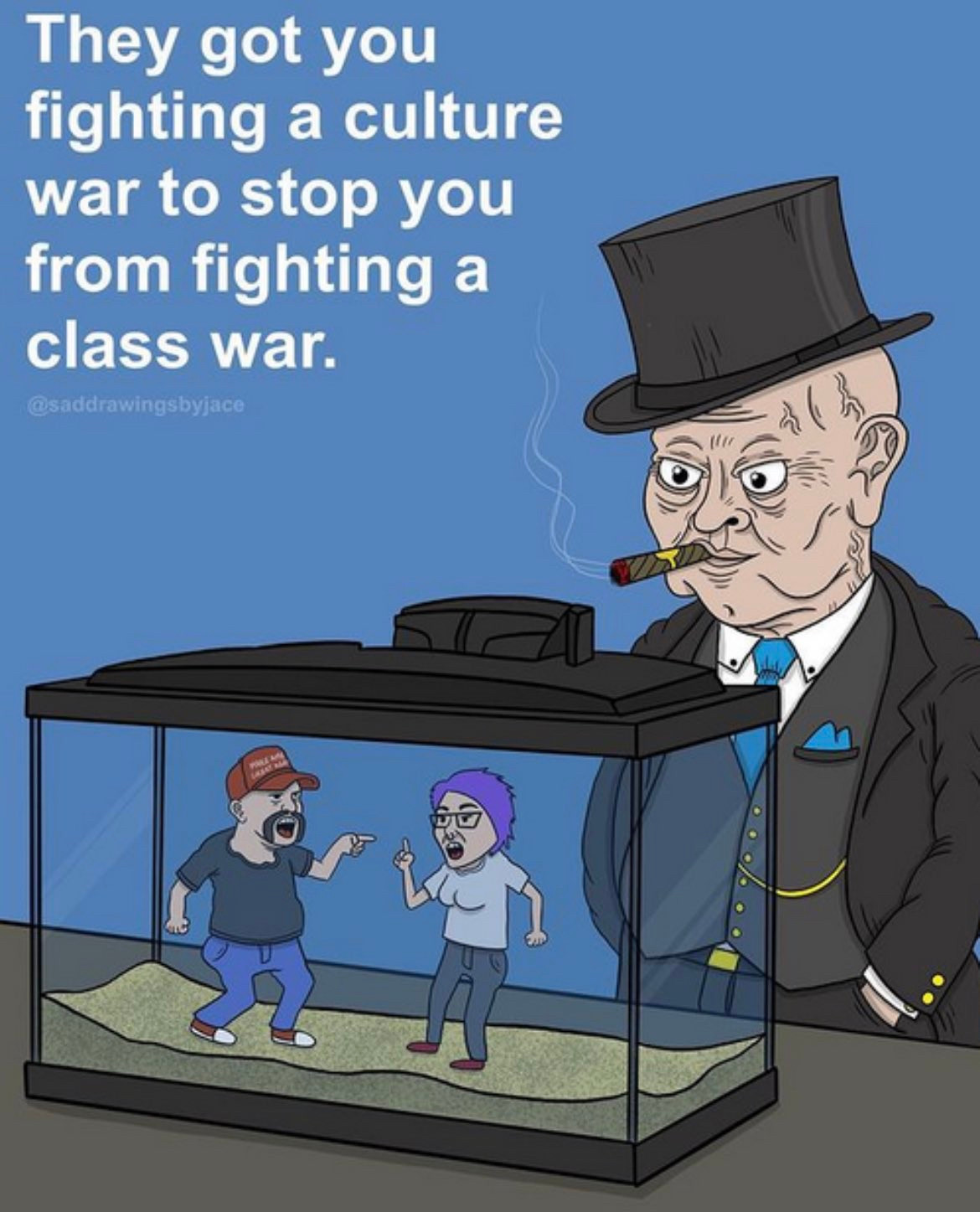
When we don’t make any space to allow for people to change and reintegrate, then we are guaranteeing that they will choose the more viable option for their social survival, which is to continue on the fаscist path that they’re going on, surrounded by other people who are doing that shit. We are also playing right into the hands of capitalists, who fucking love it when we see each other as Democrats, Republicans, Liberals and Conservatives rather than working class people. They’re roaring with laughter at us inside their skull-lined caverns full of gold coins, while we stand outside the castle yelling at each other instead of turning to face them.

There’s a weird situation on the left where people believe a lifelong gang member can be reformed, but not a conservative. (It’s possible I’m overestimating how many people are abolitionists who even believe the first one, but I like to hope we’re further along than that.) The reality is that there’s plenty of evidence for both: people who have done harm or believed harmful things can and do change.

This is an essential subject to talk about, because we badly need information from those who escaped right wing cults so we can understand how they draw people in, and intervene in that process. We need stories of people who were raised conservative coming around to realize that they’ve been lied to. We need to practice talking to people who have contradictory, misguided, propagandized beliefs in order to build a viable working class movement. If you appreciate the political work of literally any person who is white or a man, you can thank the people who helped them deconstruct the beliefs and behaviours they grew up with. When we foster an environment in which people are shamed and shunned for being honest about their deprogramming journey, we are depriving ourselves of an incredibly important resource.

It’s emotionally easier to believe that other people can’t change, because changing them is exhausting work and most of our experience with that is with family members, strangers online and other people who are seemingly irredeemably stubborn. But it’s also exhausting partly because we’re using the wrong tools for the job. We’re wildly under-resourced, and that’s been done to us on purpose: centuries of domination, forced competition, trauma, traditional lifeways and practices stolen and coerced and beaten out of us. But we still want to try, because we’re desperate. So we use the tools we were given by the same shitty society we’re trying to change: shame, judgement, berating, dominance, arguing, dehumanization, bad faith interpretations. We don’t first put the work in to build a trusting, mutually respectful relationship. We don’t try to really understand where another person is coming from, see their pain and struggle, and meet them where they’re at. That’s an uphill battle when we’re so starved for recognition ourselves. It feels unfair to have to be the one to offer empathy first. So instead of trying to bridge the gap and connect, we non-consensually shove facts and logic at them, call them bad people, tell them they’re wrong and problematic, vent our anger and disgust. We expect that to work, because we’re exhausted and we want it to. Then we get mad at them when they’re defensive and repulsed. They then go back to the people they feel safe with, the people who don’t challenge them in any way and have politics that are ecocidal but who also make them feel accepted and cared for in some way, and we throw up our hands and say “see? These people refuse to change!”

Parenting has been the most shocking, revolutionary experience I’ve had in a lifetime of learning. It’s like seeing into the Matrix: everything adults do that is annoying and dangerous is just something that wasn’t intervened in with empathy in childhood. For example: my 4-year-old does not want to wash her hands. It is the hill she is determined to die on, every single day, and it’s not an optional part of life. I am absolutely sick of it. It feels like I’ve tried everything, and I can feel the exhaustion taking over when I am tempted to just grab her hands and wash them for her while she screams. But force does not create healthy development. Just because I think she should know better, doesn’t make it so. Just because it would be easier for me if she just did what I told her to do, doesn’t make that actually happen. We spend a lot of time wishing reality were different, which stops us from seeing things as they are, and working with them. This is a form of healing that I’ve learned from plant medicines and Buddhism, and it’s made me a better parent and a better organizer. Instead, I strive to understand my 4-year-old’s aversion. She is probably also exhausted from a day spent being told what to do at school. She has sensory sensitivities and the soap is slimy. She is wired for play and novelty, and washing your hands sucks and is boring. If I understand where she’s coming from, I can help meet both our needs by turning handwashing into a game, or . Do I want to make a goddamn game out of handwashing when it’s 9 pm and I just want her to go to bed? Fuck no. Is it still good practice to try, whenever I can? Yes! Because when I push myself to do things that are tiring but align with my values, all sorts of benefits arise that I otherwise am blocking myself from. It feels better in my soul. I’m connecting with my kid, I’m connecting with my own joy. I never regret at least trying.

When we try using our same old tactics to change people, and fail, and decide that they must be unfixable, we are depriving ourselves of an opportunity to learn from the situation and better hone the most important tool of all—determining who is too far gone to be worth the energy vs. who can be brought around, and focusing on the latter group. We end up with a self-fulfilling prophesy of “nothing can be done,” retreating further and further into the safety of only engaging with people we deem to be Good who have our exact same politics. Which leaves everyone else, all the imperfect, lost, confused, lonely, well-meaning people who’ve been heavily propagandized and raised in a dysfunctional, racist and capitalist society, wide open to being scooped up by the people who are willing to or are paid to scoop them up.

It’s not working, fam. I want liberation and I’m willing to humble myself and try any tactic. I don’t want to look my kids in the eye as the ecosystem collapses and say “sorry, I was going to do everything I could but emotionally regulating myself enough to have frustrating conversations and choosing where to spend my energy wisely was too far.”

One of the problems, and it’s one I am complicit in, is that rather than focusing on fаscіst dogwhistles or racist microaggressions or sexist tropes or people who voted for X politician–specific behaviours that people engage in–we frequently use terms like right-winger or racist or misogynist. People are always more complex than whatever label we give them. This entire project becomes much easier if we see our fellow working-class people as people rather than as identities or labels. Labels can be useful as shorthand, and I’m certainly not against calling the most obvious and dangerous cases what they are–for example, JK Rowling is a transphobe. But labels are inherently flattening and dehumanizing, and dependence on them is dangerous. We risk eventually believing through repetition that the labels are reflective of objective reality, where reality is always more complex than any label can describe.

As always, by communicating all of this, I am not saying you personally have to do anything. You don’t have to personally fix your MAGA uncle or coddle Yahtzees. If that’s what you think I’m saying, then there’s a fundamental communication disconnect, so please feel free to go do whatever aligns with your values. What I am doing here is offering information and suggestions to better inform and hone our tactics on the left. This is for people who are committed to movement-building praxis and are interested in challenging themselves. Building a working-class movement requires us to engage with people who have all sorts of weird and incongruous beliefs; any seasoned organizer can tell you this. 100% of the people we need to talk to in order to grow the movement are not yet radicalized into liberationist politics. Most people are not hardcore white supremacists with a coherent worldview. They don’t realize that their weird misgivings about trans people or their reflexive defenses of Taylor Swift are a result of a colonial/capitalist project designed to turn them against their own interests. And personally, I don’t ever want to have so much confidence that I’m one of the Good and Correct ones that I support a system in which we have to lock the Bad and Wrong people up (or worse). The leopards will always come to eat our faces too.

So, what can we do?

If you do feel ready to do this deep, difficult, rewarding work, here are my suggestions. But first, I want to express my gratitude to you, because it’s honestly REALLY fucking hard to push past the anger enough to do this. Most people are not resourced enough for it. I struggle with it all the time!

Identify which of your identities makes you best suited to talk to other people with that same identity. As much as it sucks, I have to talk to white people because they are more likely to listen to me than the Black and Indigenous people I have learned from. It’s a responsibility, but also an opportunity. Men, talk to other men. Straight people, talk to other heteros. Religious people, talk to others in your faith. Non-Indigenous people, talk to other settlers. Most of all, working class people, talk to each other about class issues! (Class is generally the most productive place to focus your efforts in my opinion, because it’s the great uniter, and the reason we were divided against each other by capitalists in the first place.)

Here are five resources I suggest to start with to build these communication and organizing skills. None are perfect, all are just tools in a toolbox. Pick whichever interests you, leave anything you don’t feel aligned with.

1) Nonviolent communication training: an incredibly resource for learning how to talk to and connect with people using a non-authoritarian approach. (This is where I learned to identify how often people interpret suggestions and requests as demands, a quick way to see how unresolved trauma functions to hamstring our movements.)

2) Let This Radicalize You by Kelly Hayes and Mariame Kaba: practical advice for organizing and activism, and how to make hope something that you build with others.

3) Maybe I’m cheating by calling this one a single resource, but it’s just too good! Interrupting Criminalization has got so much! Use it all, share it all! They are amazing!

4) Shaun does amazing work speaking to and about young white men from a critical but also humanizing perspective. Here’s another of his videos, and more resources I’ve compiled for fostering positive masculinity.

5) This one is a bit of a spicier recommendation, but if you’re ready to go even deeper and see how spirituality is an essential component we need to integrate in order to combat the appeal of fundamentalist cults, then listen to The Emerald podcast. “Oh Justice” is a relevant episode, but listen to any that pique your interest. My favourite is “Snail Juice.”

Be well, keep up the good work, rest and find joy. I love you, we’re all in this together.

If you appreciate the labour that went into this article, please share it with others! Here are three ways to say thank you, and support me doing more of it:

❤️ Join my Patreon 

💲 Send me some cash I can use to pay rent

👧 Buy my kids supplies like toothpaste and sunscreen!

Dr. Hilary Agro is an anthropologist, community organizer and mother of two young children.

Can you be a parent and an activist?

I am consumed by a difficult realization I’ve come to lately.

The care my children need to be as protected as possible under the conditions of capitalism outstrips my ability to provide it while also doing activism.

It’s hard to admit, but I didn’t put very much thought, before having kids, into how much doing so might take away from the activism that’s been the bedrock of my life for over a decade. Attempting to maintain the same level of productivity in my work and organizing while parenting two small children has so impacted my physical and mental health that I believe I have finally, just recently, hit extreme burnout.

My body aches at all times. My hips are in pain, possibly due to the double C-section scar that I have not given myself the time to properly heal, because who has time for that when there’s an overdose crisis and people are dying? My teeth grind at night, possibly because I have not let myself access the amount of rest I’d need to relax my body, because who has time for that when there are multiple genocides happening? The pain in my back starts at a 4 every morning and ramps up to an 8 by the end of the day, because who has time to do yoga when the oceans are acidifying and the forests are burning and leftists can’t stop angrily venting their trauma at their fellow working-class people for long enough to build a movement that can turn this ship around?

I turn this physical pain into empathy, by thinking about the parents and other workers who secretly use opioids to deal with the pain thrust upon them by the demands of capitalist (re)production. I finally get, on an embodied level, why they do it. I wish more people would understand that drug use is a rational response to a violent society, because if they did, we might stop throwing people who use drugs in prison and taking away their children. My pain turns into wisdom, and I feel compelled to share this wisdom with others, so I do. It feels so urgent. A more pressing demand than taking twenty minutes out of my day to massage my C-section scar and do physiotherapy for my diastasis recti. So the pain lingers in my body, like a poison made of urgency, of the screams of dying Palestinians and old growth forests.

I do not believe that parenting on its own is enough of a contribution to building a better world, as many people say it is. Just “raising the next generation with good values” is not enough when our land, air and water are under such dire, immediate threat that by the time my children are adults, they may not have anything left to survive with. The problems are too urgent for parents to do nothing but raise our children well. But how much labour is enough?

I made my decision to have kids before knowing that a dangerous virus would be threatening us for years on end. Before knowing how little I would be able to rely on the Canadian medical system, or any other system, or even my own community members, to protect us. I feel naive, but I see people still making the (to me, at the moment, somewhat baffling) decision to have children, so it would seem that either the gravity of the threats facing children right now are not actully as severe as they seem to be from my ostensibly well-informed perspective, or most people, even leftists, are in denial about the dangers and the weight of responsibility that comes with bringing children into the current world. Or perhaps, as a neurodivergent person in trauma recovery whose disabilities did not become so acutely obvious and pressing until after I had kids, I am simply far less equipped than most people to handle the stresses of parenting. But I’m not sure I’m so unique, as our society is disabling and trauma-creating on a scale wider than most people realize.

To keep my kids truly safe, I would need to join their school’s PTA and devote all my time to ensuring quality air filtration in their classrooms. I would need to spend the few spoons I have on teaching them to wear masks in indoor public spaces and convincing them to keep doing it, every day, even when it’s uncomfortable, even when no one else is doing it.

I would need to teach them how to garden, to build their connection to the land so they become naturalized citizens of this place, and learn to care for the land that cares for us, as well as survival skills for what may come.

I would need to prepare weekly activities that make them into good neighbours and citizens. Writing thank-you cards, preparing gifts for their friends, baking cookies to bring to parties.

I would need to expose them to Mother Earth, creatively teach them to understand and love trees so their ability to see and appreciate nature doesn’t wither under the ten-tonne weight of the cartoons and superheroes vying for their attention and filling their brains with cravings for plastic toys and refined sugar.

I have been doing some of this already. But the parts I’m able to do are already more than I have the capacity for. So where, in all of this, is there time to organize my community? How can I attend socialist meetings with an energetic three-year-old? How much of my limited supply of energy can I give to exposing myself to enough information about the various ongoing genocides that I am able to take action to stop them, without becoming incapacitated for the evening when my third labour shift of the day starts? How can I do all of this while also finishing my PhD, taking care of my relationships, and maintaining my physical and emotional health?

These are questions I have been struggling with, with no good answers. I am not currently striking a balance. Maybe when they’re older, I can more easily involve them in organizing activities. Does that mean that while they’re 3 and 5, I can take a full break from all of it? When do I start up again? Which aspects of my caregiving or my community organizing can I sacrifice?

Caring for two small children on my own, which I often do these days, means the built-in stress levels of my day-to-day are high. It requires large amounts of patience, recovery time, and practicing emotional regulation skills to parent with only sporadic community and family support. It’s easy to say “cook with your kids,” it’s harder to put that task into practice when half of your time and attention is spent intervening in messes, breaking up fights, rushing a toddler to the bathroom, and attempting to give two children 100% of your attention when at most they can each have 50%. In the evening, you have to try to do all of this while you’re already exhausted from a full day of labour, and facing down another endless bedtime (my 3-year-old Mila does not, and seemingly cannot, fall asleep until 10 pm).

And all the while, underneath, there is the gnawing tension of the knowledge that good participatory habits must be fostered early—if you wait until your kids are old enough that they’re better able to stir soup without spilling it or carry a carton of eggs without dropping it, by then they won’t want to cook with you at all, because the early flames of their desire to will have died out, tamped down by their cargivers’ exhausted impatience and redirected towards toys and screens.

Children can sense the neglect inherent to the nuclear family arrangement, and it upsets them. They need so much more than one or two caregivers can provide. My 5-year-old Eva is increasingly frustrated with my inability to read to her for as long as she would like because of the demands and interruptions of her younger sister. Meanwhile, Mila is the most extroverted human being I have ever met (you think I’m exaggerating, but I’m not) and is the easiest kid in the world if many people are around for her to interact with, but if you’re on your own with her, you do not get a break. I don’t have the energy or time for much creative play because I’m so busy meeting their basic needs and teaching them functional skills, and most of the time there are no other kids around to meet their very high need for play. It’s wonderful when they play with each other, but more often than not it ends in tears and rage as I cannot supervise closely enough to make sure Mila doesn’t grab Eva’s toys while I’m making their breakfast. Humans were not meant to live in isolation like this. It’s simply not possible to give children everything they need under these circumstances, and that’s without adding the extra pressure to stave off environmental collapse.

I do have friends who help me out, and they are lifesavers. The tiniest act—playing with my kids, washing a few dishes—fills me with overwhelming gratitude. I have especially noticed that my comrades who are the most accomodating and helpful are the ones who are the most embedded in liberationist politics, which is beautiful and, I suppose, unsurprising. The ways in which liberation-minded people are trying to live our values and build the communities we want to see gives me hope (though it also comes with complicated feelings—I cried with equal parts relief and deep guilt when my Palestinian friend offered to come vacuum my apartment when my vaccum broke, at a time when her people were and are being genocided). But these are also friends I’ve made largely through my activism—what happens if I give that up for several months, or a year, or two? Will they still show up for me if I’m burnt out and unable to reciprocate any community work? I need so much because my children need so much, and there’s so little I can offer in return right now. How much can I rely on my already overworked and burnt out friends, most of whom are BIPOC, queer, and/or disabled?

I can see, like I’m Neo at the end of the Matrix, exactly how all of these pressures create the desire to make more money. Money can solve many (though not all) of these problems, so buckling down and focusing on securing income for your own family feels like the only option. And once you do that, you’re hooked—the desire to make money in order to feel safe and afford the supports you need becomes its own self-sustaining capitalist illness. There but for the grace of my own neurodivergent stubbornness, and years of exposure to anarcho-communist principles and Indigenous ontologies, go I.

What to do, then? My bones are creaking. My mind is consumed with grief for the state of our world. It’s too much. I have recently decided to take a medical leave from my PhD to focus on getting my health back in order. I’ll be putting a pause on most of my activism as well, which will be the hardest part. But something has to change. I love myself, my kids and my comrades too much to not try to find balance. I cannot tell others that this is a marathon not a sprint, take care of yourself and all that, and not follow my own advice. I am going to reset, spend time with trees, and figure out what a sustainable work/life/activism balance looks like for me now.

Most parents in your community don’t have the ability to do this. They are drowning.

I know that many people, given how empathetic and kind my audience generally is, will want to soothe and reassure me that I’m doing the best I can. You may want to offer tips to improve my situation. I do appreciate and welcome this, but what would truly make me feel better would be if you commit to helping your comrades who have children, and talk about it publicly. You really can’t imagine how much stress they’re under. We have so normalized the idea that parenting is naturally exhausting, many parents don’t even realize that they should not have to suffer like this. Child care is mutual aid, and one of its most neglected and essential forms. I would probably cite Silvia Federici or Sophie Lewis here if any of their books existed on audiobook so I could read them, lol.

So, what can you do? Here are some suggestions:

  • It’s hard to get kids out the door to go to things, so go visit your friends with kids. Ask what help they need, and if they’re unsure, the kitchen or bathroom is a great place to start. Bring food.
  • The best thing for the whole family is playing with the kids themselves, as you can give parents a break while simultaneously providing something that kids badly need, which is socialization with people beyond their primary caregivers.
  • Many of us parents fall into the instinct to zone out on our phones when we get a second of reprieve. If you’re offering to take care of the kids for a bit, gently ask your friend to think about what they might want to use that time for. If it’s zoning out on their phone, that’s fine, but just a little orienting question to help them be intentional about it will help, and it may make them more likely to do something more restorative with their time.
  • Offer not only to go on outings with your friends and their kids, but offer to meet them at their place first to help get the kids out the door.
  • Hang out with your parent friends while they’re in the park so you can chat while they kids run around the playground. Host gatherings in kid-friendly spaces.
  • Talk to others in your leftist organization(s) about accomodations for parents. Can you provide engaged child care at meetings? Can you help parents get to meetings? If your group is small, can you commit to meeting at the homes of people with kids, if they’d prefer that? Can you bring snacks/food to family-friendly actions, and state that on social media so parents know they don’t have to do the added labour of packing snacks?
  • Wear masks in indoor public settings. Fight for better air filtration in these same settings, or bring your own air filters to events/gatherings. Open all the windows.

Thank you, beloveds, for reading all of this, and for thinking about what I’ve offered here. Please share this post on social media so it can start discussions about these issues. Do you have similar experiences or insights to share? Am I the only one going through this?

One thing, though–note that if your instinct when you share this is to talk about how all of this is why you decided not to have kids, that’s fine, but please temper it with a stated commitment to helping other peoples’ children survive, as it can otherwise come off as dismissing these common concerns as the fault of individual parents’ decisions to have kids, when doing so is the most normal impulse in existence and shouldn’t be shamed. If we want to build a better world, we need to support parents, as they are the primary caretakers of the next generation that will help us survive in old age, and will pass on our teachings. More than anything, because children deserve so much more love and care than they are being given under the current conditions. You do too. We all do.

Hilary Agro is a community organizer, low-income PhD student & mother of two young children. If you appreciate the labour that went into this article, consider sending me and my kids some masks, HEPA filters, diapers or books, or just a cash tip

Fear and Loathing in Atlanta: Racism and the War on Drugs

Content warning: racism, violence, forced miscarriage.

I was on my way to the airplane that would take me back home, to Canada. I boarded the train between the Atlanta airport’s two terminals, eyes bleary from sleep deprivation and last night’s makeup. A blind man and an airport employee helping him walked onto the train, led by his dog. Minutes passed in silence before he told a story, out of the blue, foggy eyes staring at nothing.

“One time I was leaving a store, and my dog, she led me into the wrong car,” he said to his helper. “It wasn’t my wife in the front seat. ‘I think you’re in the wrong car,’ I heard a woman say. ‘I think you’re right,’ I said.”

I shifted my backpack and smiled at the story.

“I’m just glad she didn’t have a .45 on her,” the blind man added.

“Yeah. That would have been messy,” the helper responded.

They said it seriously, but so casually. Like it was nothing. Normal.

I couldn’t take it anymore. I broke down crying.

* * *

Just five days in the U.S. south, at the International Drug Policy Reform Conference, changed how I view the work I’m doing. I’m a PhD student who studies the effects of drug prohibition on drug users and sellers. I know about gun violence, about racial oppression, about how the War on Drugs systematically targets the poor and people of colour. I’ve read everything I can get my hands on, I’ve watched the documentaries, I’ve talked to people, I’ve done a Master’s degree’s worth of ethnographic research on the subject. I’ve lived in Mexico and seen the ugly effects of cartel power in person. There’s a reason I’m doing this work. But I’d never seen what I saw in Atlanta, so much in so few days.

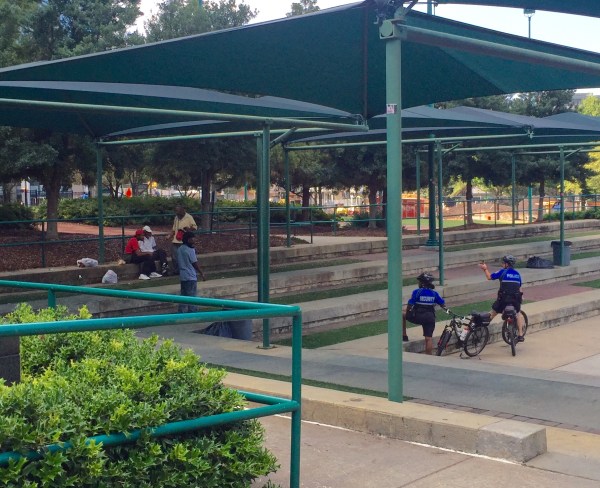
Monstrous things that seemed to faze no one. Monochromatic homelessness, all black. I was catcalled constantly on the street, and then later told I was an idiot for walking alone at night at all – you can’t do that here. The transit security guard on the subway had a gun. I guess all of them do. I got a physical shiver when I saw it, a weight in my stomach. I couldn’t remember the last time I saw a gun in person. I live in the kind of place where you can go months, even years without seeing a gun.

Photo 2017-10-11, 1 04 06 PM

A group of black men being bothered by cops for no reason I could discern, one of the first things I saw when I got into the city.

I heard story after story of people being arrested for drugs, years of their lives and their mental and physical health taken away from them, families destroyed. Racial tension was everywhere. Fear was everywhere. Buzzing, insidious, toxic textures at the periphery of the senses. Fear seeped from the walls and coated every interaction. Hackles raised, human connection difficult without concerted effort. I made the effort and was rewarded with tiny moments of solidarity, bright sparks, smiles. Atlanta, like the US as a whole, is full of good, kind people, trapped in a cultural venn diagram of overlapping toxic systems that are slowly killing them and keep them turned against each other instead of against the systems themselves.

White supremacy is real, and it is everywhere. The geographic and economic segregation along racial lines was astounding. I sat eating a Big Mac in a McDonald’s at 11 pm on a Wednesday, the only white person among 30 black people. I then walked six blocks north and was hit by a wall of white bodies in confederate flag shirts—returning from a Garth Brooks concert, I later learned. I was very uncomfortable in the latter situation and felt fine in the former, but the sheer, naked, normalized segregation in both made me deeply uneasy.

I sent my partner a drunk text about how the food here didn’t feel digestible. That Big Mac haunted me. It was like eating ash and plastic, no nutrition at all. You don’t have to believe me, but I mean this honestly when I say that American fast food is worse than the fast food I’ve eaten in any other country. You can taste the difference in agricultural production and food standards. It hurt to think that it’s all that millions of people can afford. It’s barely food. They deserve so much better.

Photo 2017-10-14, 3 21 11 PM

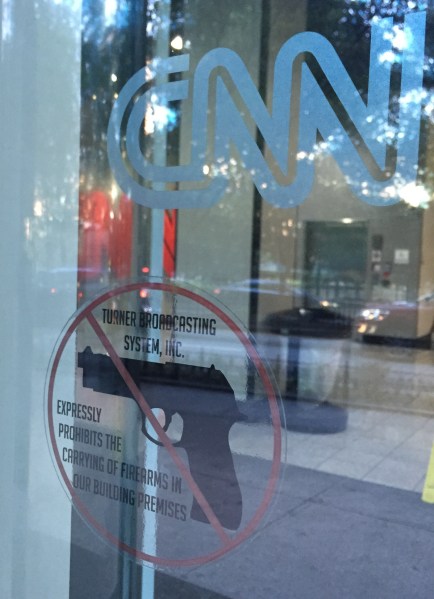
These signs don’t exist where I live

I fended off catcalls as I walked home that night, a deep sense of shame and disgust at my skin colour setting in already, at how I was necessarily perceived to be one more white link in the chains that hold half that country hostage. I couldn’t hide my whiteness, so I shamefully found myself hoping people would at least notice my broken glasses and crappy old boots and think I’m poorer than I am. I’m not wealthy—I just barely identify as middle class—but I am not poor. Not like the homeless man to whom I gave my change instead of all the money in my pocket like I should have. My partner and I don’t make much money, but with free health care and the various other social and academic supports I have access to, I can afford to fly to conferences in other countries where I deal with the embarrassment of being a walking pile of privilege by hoping my taped-up glasses camouflage my relative wealth. I have to remind myself as I walk by that those people don’t have nothing because I have something: those people have nothing because a small handful of people have everything, and will not share until we make them. I channel that knowledge back into my work. Guilt is not productive. Action is.

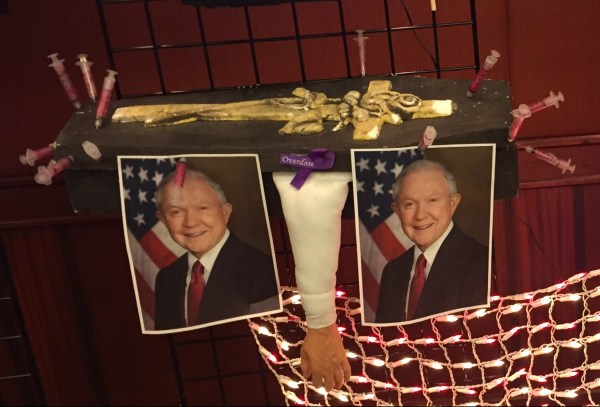
jeff sessions is an absolute monster

So much blood on this man’s hands

The next day at the conference, I listened to a formerly incarcerated black woman on a panel tell her story. She was in federal prison for selling drugs, and she was pregnant when she was locked up. The water that came out of the taps in the prison was brown. She told them she couldn’t drink it, and they told her to go thirsty. One day, she began feeling pain in her belly. They took her to the infirmary—they didn’t have the right paperwork to get her to a hospital, and didn’t bother finding it. They shackled her, bleeding, to the bed, as she begged for help. She miscarried and lost her child. They threw her sheets, and the fetus, into the trash. Soon she was forced to return to her “job,” welding bunk beds for the men’s prison. Three beds high, three feet of vertical space per bed. The audience quietly cried as we listened. She sold things to people who wanted them, and the state robbed her of unborn child and gave her post-traumatic stress disorder.

Hers was not the only story like this.

* * *

Photo 2017-10-12, 3 59 53 PMI was saved by the people at the conference, hundreds of tiny lights in a landscape of confused darkness. Activists, scholars, authors, health care workers, psychonauts, researchers, patients, libertarians, socialists. All of us bound together by the knowledge that drug prohibition is the modern day Jim Crow and the driving force behind death and destruction in the Americas. We clung to each other for sanity, sharing our successes and failures, our experiences, our self-care rituals. Every victory was tainted by the knowledge that while capitalism stands, its vultures will always find a way to profit and oppress. Marijuana is being legalized—great! But anyone with a felony record is barred from working in the legal market, meaning all the people of colour who were selling it before—shit. Companies who make ankle GPS trackers, video call systems for prisons, and opioid medications pour billions of dollars into lobbying to maintain the system the way it is, while Black and Latinx communities have their young men stolen from them and their women and children surveilled by the state through the welfare system.Photo 2017-10-12, 6 42 40 AM
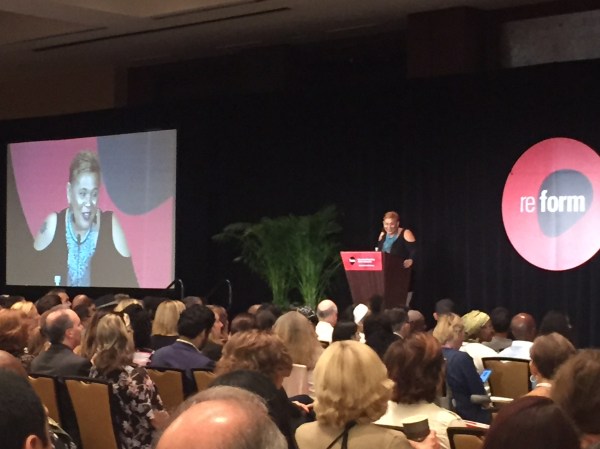
“Poor activist communities are being destroyed by the prison system,” said one panelist. “If you want to disrupt social justice, put all the men in prison and all the women under welfare surveillance.”

One woman on a psychedelics panel was asked about her experiences. She said she could never fully relax and enjoy a journey, given the space she occupies in the world. “Not even psychedelics can bring me to a place where I can escape from the reality of being black in America.”

Later I sat and watched Falcons fans on the way to a football game, laughing and shouting like everything was fine, and wondered if I was going mad.

Photo 2017-10-13, 8 31 07 AMSometimes, among drug policy activists, it feels like we’re the band playing on the Titanic. Sometimes it feels like maybe we can make a difference, like we’ll win. Like there’s no way we can’t win when all the evidence, and all the empathy, is on our side. But it doesn’t matter either way. We have to try. There’s just no other option.
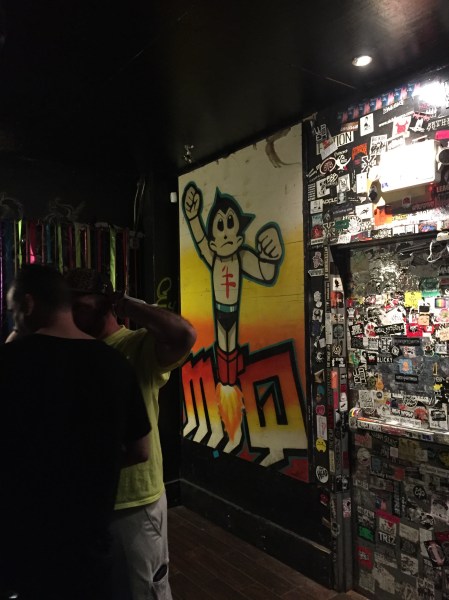
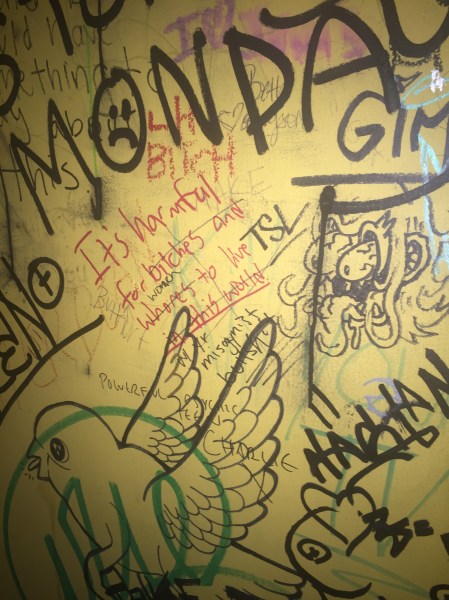
We have to do this work. Or who will?

* * *

Tiny squares of paper, an unlikely team: Leslie, from San Francisco, and Mark, a 21-year-old from New Mexico who’d never been outside his home state. All conferences have a culture of drinking—the culture at this one is a bit more unique.

Fear and loathing in Atlanta, hotel escalators like an Escher drawing. We managed to get to a club, where I danced like I could drown out my thoughts if I just moved hard enough. I listened to the lyrics of all my favourite hip-hop songs as if I’d never heard them before. Pain, power, poetry. They wrapped around my heart and pulled it down into the ground. The energy on the dance floor, the smiles, the movement—they crackled with intensity. I never wanted to leave.Photo 2017-10-14, 9 17 08 PM

Later, we stayed up til long past sunrise, trying to make sense of what we’d experienced that week. Legs stretched out on the hotel carpet, ears ringing. Talking to Leslie that night had been a moderating influence in the stark differences I kept seeing between our two countries. There were certain things she said didn’t exist in San Francisco either. But still, I began to feel terrible for how many times I pointed out how things like needing to carry mace with you is not normal in Canada, and should not be normal anywhere, let alone a country with this much wealth and resources. Transit officers with guns on the subway should not be normal. Having to ask whether the tap water is potable should not be normal. Fearing shootings in public should not be normal. Spatial segregation by race and class in a multiracial society should not be normal. Having to create GoFundMes to pay for surgery should not be normal. People fighting tooth and nail to keep professional sports team names that are straight-up racial slurs should not be normal.

Canada, like every country, has many serious problems that need immediate attention. I could write endless pages about what’s wrong with the capitalist, colonial state that I live in (and I often do.) Racism, inequality, misogyny, homophobia—they all exist in my home too. But it’s not the same. It’s just not.

Sometimes, we just sat in silence, the weak morning sun peeking through the hotel curtains.

“I’ve been very angry and afraid of other people for a very long time,” realized Mark numbly.

* * *

Photo 2017-10-14, 11 26 02 PMI’m not naïve: I knew all of this existed. I’ve been obsessed with American politics, how similar our two cultures seem until you scratch beneath the surface, for years. It’s not possible to be a hip-hop fan from a young age, or study the War on Drugs for a living, and avoid the global vortex of injustice and power that centres on the US. But knowing about it, and coming face to face with the sheer day-to-day mundanity of it all, are two different things. I’ve been all over the West and Northeast, where the cracks in the cultural pavement are more subtle, but touching and seeing and smelling a Southern American city for the first time, while listening to first-hand stories from around the country, poured gasoline on my deep belief that to accept conditions like this as “just the way things are” is the most dangerous possible reaction. The normalization of structural violence, white supremacy and drug prohibition allows all of it to continue, at a scale that boggles the mind. I don’t want to become complacent. I don’t want to get used to it. I don’t want to accept it.
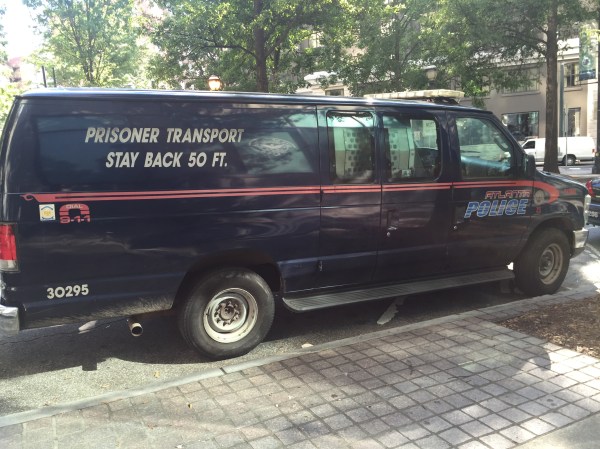
Judges who own bail companies and have shares in private prisons is not okay. A man facing five years in prison for picking mushrooms in a forest in Washington is an outrageous injustice. Thousands being held without even being charged, imprisoned for the crime of not being able to afford bail. Dozens of people shot every day by police. Women sexually violated by roadside cavity searches. All because human beings like getting high, and a group of wealthy, powerful people figured out how to turn that desire into capital by weaponizing racial oppression.

None of this is okay. Nobody deserves this kind of life.

I love Americans, I really do. They are incredible people, and so many of them have accomplished amazing things in the face of all this oppression. Watching American activists at work, fighting tirelessly under such difficult conditions, inspires me every day to work harder, work better, listen more closely, see more critically. But the country itself, the ideas that prop it up… How can we wake up the white American prohibition-supporting mainstream—which includes most liberals—to what is happening to people in their own country because of their complacency? I want to run around and shake people. Rip out the tentacles of media propaganda poisoning their minds, convincing vast swaths of the US that it’s their neighbours who are the problem, not corruption and inequality.Photo 2017-10-11, 12 54 33 PM

I guess it’s easier to be in denial, to feel like surely all those black people are wrong, overreacting with their protests and kneeling, than to confront the fact that your whole worldview is based on a mammoth lie. They’re like cult members—they just double down on their beliefs when they’re confronted with reality, because changing those fundamental beliefs, admitting the lie, would be too painful to bear. Maybe that’s how we need to start treating Trump supporters: like cult members who need deprogramming. They’ve bought into a certain narrative, that the US is fundamentally good, and to shatter that illusion would destroy a part of their very identity, their sense of self. Maybe we need to give them an out that allows them to shift that narrative towards something that provides the same positive identity, but acknowledges the truth: if you love your country, the most patriotic thing you can do is help to make it better for everyone in it.

* * *

It was Sunday morning. I’d slept for two disoriented hours. As I walked towards the subway train that would take me to the airport and the sweet sanctuary of home, I was torn between desperately wanting out, and feeling an urgent need to stay—there’s not enough time, I need to talk to more people. As if there could be an amount of time, or enough conversations, that would quiet the existential dread in my belly.

I passed a Muslim family outside the subway station. I wanted to run up to them, to every person of colour I saw and tell them I’m sorry for how hard it is to be them on this continent. I want them to know that I see them, I see what the world is doing to them, and it’s not okay, and I’m doing what I can to change things. That their experiences are real and valid. I don’t want to be one more person feeding into the twilight zone society that pretends this isn’t happening.

Photo 2017-10-12, 7 06 38 AMI’ve been texting with Mark regularly since I got back. We supported each other through our re-entry. “I was in a weird fugue state for a week when I got home,” he told me. “It felt like everything was going in slow motion.”
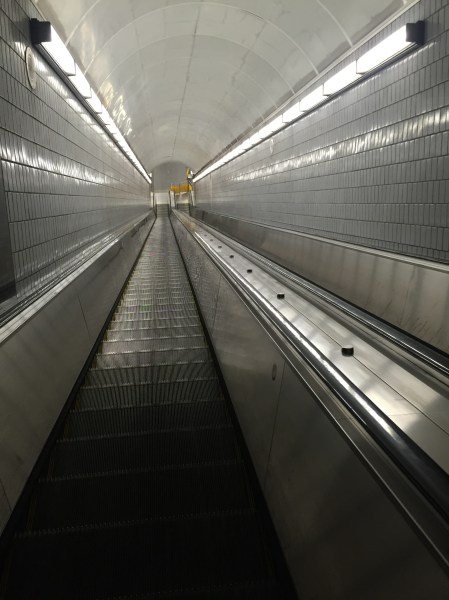
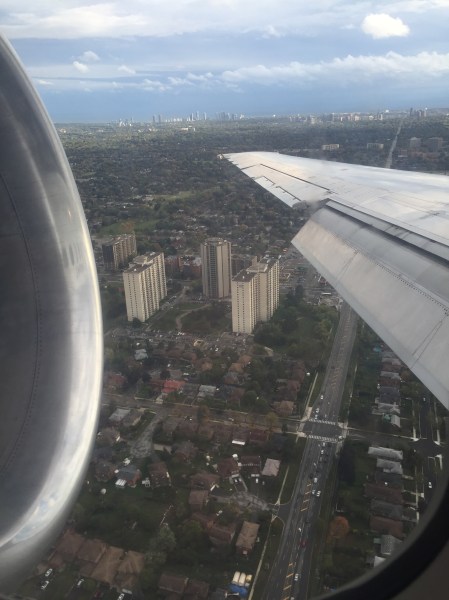
The airport alone was a surreal experience. I kept seeing innocuous but slightly bizarre things. I saw ads about “shopping for health care” and thought, those words don’t make sense together. I watched a man in the seat ahead and across from me sit and read all of the Wall Street Journal. He spent a particularly long amount of time on an article called “NFL weighs new anthem rules.” At one point, he pulled a wad of bills out of his pocket, counted them, and then put them back in his pocket.

I watched the guy next to me do a crossword puzzle, and it felt… I don’t know. Amazing. Ridiculous. Something. How can you do something so benign and simple and quaint and pleasant when the world around you is falling apart? How can you be so calm when 96 of your fellow citizens will die today from being shot with a gun? How are you not screaming with pitchforks at the front gates of every billionaire’s house?

I wanted to turn to the people across from me and ask, “Did you know that we’re living in the darkest timeline and everything we’re told about the way things work is a racist lie?”

But I couldn’t figure out exactly how to word that, so instead I asked them about football.
Photo 2017-10-11, 12 06 11 PM

I did talk with another Canadian headed to the same flight as me, and told her how I was feeling. “Atlanta is nothing,” she said. She’d gone to school in North Carolina, and left when she was done her degree because, she said, “it was too racist.”

* * *

When I started crying on the train after the blind man’s story, I couldn’t stop. I made my way to a fast food area with tables in the airport, sat down and sobbed. A woman—this woman—was playing the cello nearby, and I lost myself in the music, slow and sad. My body heaved as I wept. I was ignored by the other people at the tables. No one said a word to me.

By the time the music finished, I had too. I locked eyes with the cellist, whose name turned out to be Jenn, and she walked straight over to me as I stood up. She embraced me tightly, and I felt everything all at once.

We broke apart and I thanked her for her music. “I needed that,” I said.

“I could tell,” she answered. “Is there anything you want to share?”

We talked for a while, with another woman, and every second was both confusing and nourishing. Nothing I managed to verbalize about my feelings seemed to surprise them, and they were sympathetic. “It’s important to accept that not everyone is capable of feeling as deeply as you do,” one of them told me. It makes sense as a short term strategy, but it’s a pill I still refuse to swallow for the long-term. Everyone is capable. We’re just torn away from each other. We can rebuild empathy.

I had to go. They both hugged me goodbye as I wiped away tears, trying not to be embarrassed. “It’s okay,” I sniffed. “I’m okay.”

Jenn held my shoulders as she looked into my eyes. “It’s alright if you’re not okay, too.”

I felt the warmth in her words, and smiled. “I will be.”

* * *

Photo 2017-10-15, 1 49 54 PMOn the plane, I listened to Kendrick and let every word cut into me like wounds I never want to heal, wounds my soft, safe body will never actually have.

I’ll prolly die anonymous, I’ll prolly die with promises
I’ll prolly die walkin’ back home from the candy house
I’ll prolly die because these colors are standin’ out
I’ll prolly die because I ain’t know Demarcus was snitchin’
I’ll prolly die at these house parties, fuckin’ with bitches
I’ll prolly die from witnesses leavin’ me falsed accused
I’ll prolly die from thinkin’ that me and your hood was cool
Or maybe die from pressin’ the line, actin’ too extra
Or maybe die because these smokers are more than desperate
I’ll prolly die from one of these bats and blue badges
Body-slammed on black and white paint, my bones snappin’
Or maybe die from panic or die from bein’ too lax
Or die from waitin’ on it, die ’cause I’m movin’ too fast
I’ll prolly die tryna buy weed at the apartments
I’ll prolly die tryna defuse two homies arguin’
I’ll prolly die ’cause that’s what you do when you’re 17
All worries in a hurry, I wish I controlled things

If I could smoke fear away, I’d roll that mothafucka up
And then I’d take two puffs
I’ve been hungry all my life
I’m high now
I’m high now


If you like my writing, please consider supporting me on Patreon, or sending some diapers for my baby from my Amazon list 🙂 I’m a low-income grad student and new mom trying to fight against the devastation of the Drug War—every little bit helps.

Find me on Twitter ranting about drug policy, criminal justice reform, capitalism, psychedelics and anthropology: @HilaryAgro

Alright, let’s talk about GHB: A user’s guide. 

When it kicks in, it feels like meeting an old friend for the first time. – Daniel, 34

Few drugs are as misunderstood and stigmatized as GHB (except for acid, the king of misconceptions). GHB (gamma hydroxybutyrate), also known as simply G, is a central nervous system depressant that comes in liquid form, drank in doses of around 2 or 3 mL. It makes you feel relaxed, warm, sometimes tingly. It’s popular at raves and parties, mixes delightfully with psychedelics and is a pretty well-known sex enhancer.

It’s also a problematic drug in the Toronto party scene right now. Ask any paramedic what causes the most issues (aside from the obvious, alcohol) and they’ll unequivocally say G. I know this because I did ask a bunch of them for my research—initially assuming, based on the media hysteria around it, that they would say MDMA. Nope: it’s G. Event organizers hate it because although deaths are extremely rare, it does usually cause the most visible, paramedic-and-police-attracting problems when someone overdoses and passes out. The reputation it has for being dangerous, while frequently exaggerated, is not totally unfounded—it’s a tricky substance to dose and is especially dangerous when mixed with alcohol, a combo of factors that make it a ticking time bomb for careless, drunk bros. Last year, some of Toronto’s best and most caring party organizers were forced to temporarily shut down a beloved and usually very responsibly-attended ongoing event series as they reckoned with the legal and logistical fallout of a near-fatal overdose. I was there when it happened. It wasn’t pretty.

It’s also well known (especially among people who don’t use party drugs) as a date rape drug. While this is true, it’s not the reason that most GHB is bought, sold and consumed. (It’s also important to remember that the number one date rape drug is alcohol. And it’s even more important to remember that drugs don’t cause sexual assaults, people [and rape culture] do. And unlike guns, drugs aren’t specifically designed to hurt people.)

So yes, absolutely, GHB has partially earned its reputation as a troublemaker. However, G has some significant positives—if it didn’t, no one would use it and it wouldn’t be such a big damn problematic deal in the first place. So, look, it’s time to stop talking about drugs as if they’re just sinister little omens of risk and danger. Information on them is so bogged down in prejudice and “Danger! Risk! Doooooom!”-style rhetoric that it’s pretty much useless for actual users. Recreational drugs are fun—that is the definition of ‘recreation’—and people enjoy them because they bring a lot of benefits to their lives and are mostly harmless when used correctly. There. I said it. Apologies for all the broken monocles that popped off in shock.

This really shouldn’t be so controversial. If you want drug users to listen to you in the first place, you’ve gotta acknowledge their actual experiences. Which is, drugs are fucking fun. Literally anyone who uses them could tell you that (including alcohol users if they would admit that they’re using a drug) but we all act like acknowledging it would mean that everyone would immediately quit their jobs and get high all day.

Anyways, back to G. So, as far as we know, when used properly, GHB is actually one of the least harmful drugs. In fact, it appears to be downright benign. I haven’t been able to find any sources indicating long-term negative side effects, and believe me, the anti-drug warriors would be throwing stacks of photocopied negative articles from the rooftops if they existed. G is also, as far as we know, much less likely to be adulterated with other substances than powder or pill drugs are. Which in the age of fentanyl, is a pretty significant plus.

People use G because it feels like a mild combination of alcohol, MDMA and weed. Importantly, the biggest upside users cite is that unlike with many party drugs (looking at you, alcohol and MDMA), there’s no hangover of any kind to worry about with GHB. They take it, they dance a bunch, they get some sloppy make outs in, they go home, and they get up the next morning feeling fine. For those responsible users, what’s not to love?

Quotes from GHB users online:

“It mimics the effects of being buzzed on alcohol but you also have a nice euphoric push and everything feels nice so it’s a nice social drug at low doses.”

“GHB is amazing. Effects are similar to alcohol, but with more euphoria, less stupor, no nausea, no hangover. It makes you hungry and horny though. Completely replaced alcohol for me.”

“The buzz – very very horny, very euphoric – I would have extremely intense washes of intense body euphoria. When mixed with a stimulant the euphoria is incredibly intense.”

“GHB is the most wonderful drug I’ve ever done. When people asked me what it was like, I would always tell them ‘it makes you feel like the most popular kid in high school.'”

So G is basically a miracle drug for those who’ve figured out how to use it properly and no more than once or twice a week. But: “when used properly” is the tricky part. That’s where everything can fall apart, and is the reason G is the bane of every festival medic’s existence.

In the end, we can go back and forth forever about whether it’s good or bad, safe or dangerous, but the reality is that enough people have decided that they like it that they’re going to keep doing it and it’s going to keep being a thing at parties. And so, below, compiled from my ethnographic research on harm reduction in the rave scene (interviews with users, participant-observation at events, scouring peer-reviewed articles and other sources, generally being a huge nerd, etc), here’s some tips for how to party more safely with G. A good “spirit guide” (see here, page 100) will ask you questions about all of the factors below so they know how much to dose you. If you’re dosing yourself and you’re not willing to follow these guidelines, just don’t use it. Put the vial down. In fact, maybe think about not using any drugs if you feel you’re not up to the task of being careful about how you use them. Drugs are fun, but they are not toys. You can get badly hurt if you’re careless.

NOTE: These instructions will seem pretty cavalier to some, but they reflect the principles of harm reduction, which means I know I can say things like “don’t mix with alcohol, period” all day long but that’s not going to help people who are gonna do it anyway, so I might as well be straight about how to minimize risk while doing it.

NOTE ALSO THAT THE BELOW APPLIES ONLY TO GHB, NOT GBL. Know what you’re taking.

GHB User Guide:

1) DON’T MIX WITH ALCOHOL. Seriously. Like a single beer at most, but even then, you really shouldn’t mess around with alcohol + G together unless you know your tolerance extremely well. Be very careful. If you’ve already had a couple drinks, leave at least an hour or two before dosing with G. If you’ve already had several drinks, just stay on that train and wait to play with G another night. (Remember, you shouldn’t even really need to drink at all if you’re gonna do G—it does everything alcohol does, minus the hangover. Except, fair warning, it doesn’t taste delicious. It tastes like salty shit. And yeah I know beer is amazing, but so is not passing out and going to the hospital.)

2) Don’t mix with ketamine either, or opiates, or any CNS depressant, unless you want to risk blacking out and unceremoniously barfing all over yourself and your friends, who may not be smart enough to put you in the recovery position so you don’t aspirate on your own vomit.

3) Start low til you know your dose. Everyone’s threshold is different, and an effective dose for each person is different. Because it’s liquid (and unregulated—thanks, prohibition), you also don’t know how strong it is until you get familiar with a batch. Around 1.5-2 mL is an average starting dose to feel effects, somewhere between 2 and 4 mL is the sweet spot for most people. Body size matters for dosing G; some bigger/taller people with naturally higher tolerances have to take up to 5 mL for a good high. For others, 4 mL is enough to make them puke. A too-high dose has the universal effect of making you pass out into an unrouseable sleep for a few hours, which will scare the shit out of your friends. But since different batches vary, it’s impossible to say ahead of time exactly how much is a proper dose from a new batch. Finding your dose requires patience and doing some of the same batch a few separate times in safe environments. Don’t go for broke on day one. Just as with any drug, you have to build a relationship with it and get to know how it interacts with your body.

4) Re-dosing is very tricky. Don’t re-dose before at least 90 minutes have passed. Preferably two hours or more, and closer to 2.5-3 hours your first few times. The less time has passed, the smaller your re-dose should be, and it should always be less than your initial dose. An okay rule of thumb is to not re-dose while you still feel at all high, but even if you don’t, be careful as you don’t know how much is still active in your system. Knowing your own ideal re-dose timing is another highly individual thing that you have to figure out slowly and very carefully.

5) Be conscious of how much food is in your stomach. If you just ate a big meal, your threshold dose will be higher than if your stomach is totally empty. (This is different from most drugs, but similar to alcohol.) It’s a very good idea to have eaten at least some food before you do G.

6) Trust your friends who are responsible and knowledgeable, but beware anyone who’s dosing you for the first time without asking how much you’ve had to drink, or having a conversation about how much you want to be dosed. They are being fucking careless. Bad spirit guide! No! Put the G down, you have not earned the right to dose your friends!

7) Use pre-measured vials (most head shops sell these) or a liquid syringe (available at pharmacies) to dose. This way you get consistency and accuracy in your dosing.

8) Don’t use it every day. No negative long-term side effects from GHB use have been established (yet), however, like almost any drug, GHB can be psychologically habit-forming if used too often, and (unlike many drugs) can cause physical addiction and withdrawals if used multiple times a day.

BONUS STEP:

8) Call your congressman/member of parliament and yell at them to legalize and regulate recreational drugs so we can have actual adult conversations with each other about how to use them properly without wading through a swamp of propaganda, prejudice and unregulated substances.

The main thing to remember is that the strength of G’s effects vary widely from person to person (and even from night to night depending on how much food you have in your stomach). The line between “THIS FEELS AMAZING!” and puking and/or passing out is a pretty thin one with G. So unlike with some easier drugs like MDMA, there’s no idiotproof guide to getting a great, safe high from day one. Starting slow and getting to know GHB is essential to be able to sustainably have fun with it. You need to woo her. Be a gentle lover with GHB. Get to know her ins and outs, how she works with your body. Don’t just stumble in and nail her without thinking. No one will have a good time.

This may sound like a lot of work, but it’s really not hard at all once you practice being careful, and being careful quickly becomes second nature. (It may not be as fun and exciting to be so methodical about it, but if you’re getting off on the risk you have a whole other set of problems that a set of guidelines can’t fix.) If you do it right, you’ll end up with a drug that has mostly upsides and few downsides.

There! See? It’s not impossible, yay! Please share this with your friends so uninformed users stop G’ing out and ruining the rave scene for us. ❤


Disclaimer: With this and all of my posts, I’m not advocating for drug use any more than someone who tells teenagers to use condoms is telling them they should have sex. I just don’t have my head stuck in the sand. I’m acknowledging a reality in order to keep people safe. -H


If you like my writing, please consider supporting me on Patreon, or sending some diapers for my baby from my Amazon list 🙂 I’m a low-income grad student and new mom trying to fight against the devastation of the Drug War–every little bit helps.

Find me on Twitter ranting about drug policy, criminal justice reform, anti-capitalism, psychedelics and anthropology: @HilaryAgro


Extra reading: I kept this post as short as possible to encourage lazy readers like myself to actually read the whole thing, but there are some important points to add. Some have been helpfully suggested by knowledgeable users, feel free to leave a comment with anything you think is missing!

  • Note that this article is NOT about GBL – the dosing is different for GBL so make sure you know what you’re getting, and do additional research before you consume anything.
  • GHB is not actually measured in milliliters, it’s measured in grams. Talking about GHB doses in mL is ultimately meaningless without knowing the concentration of the solution. “If taking/purchasing GHB from someone, always inquire as to what the EXACT concentration of the solution is. If they do not know, do not ingest the substance without either using titration to determine the concentration or evaporating the solution back to powder, weighing and putting the known amount of GHB back into a solution with your choice of concentration.”
  • If you buy larger quantities to dose out, put blue food colouring in the bottle you keep your G in so that no one accidentally mistakes it for water or liquor.
  • Advice from a harm reduction expert I know: “If you’re going to mix with alcohol, it’s better to take the G first or sip it to titrate up on either drink.”
  • Stimulants/uppers can mask the symptoms of a G overdose, so you can go into an OD after the stimulant wears off. Be aware of this when mixing and don’t take more G to compensate for the upper.
  • Does my monocle joke make sense to people who don’t get the Simpsons reference? (EDIT: I have been given confirmation that it does. Excellent.)

Being a grad student with ADHD: An ode to constant ontological uncertainty.

[Hi. I’m back. I’m digressing from my usual topics to get a little cathartic and personal for a bit. Don’t worry, for the next post we’ll be back to the drug stuff.]

Reading.

Reading used to be fun.

Back when everything I read was by choice, I could curate my own reading lists that reflected the kind of narratives that kept me going, kept me hungering for more. They fed my imagination and honed my scattered brain into the hyperfocused reverse of itself.

Reading was delightful, relaxing, rewarding.

Now, reading is torture.

It’s the enemy I face off every day. Trying to wrangle sentences from social theorists into submission is the constant state of my being.

I hear my colleagues say it took them an hour to read an article that it took me an hour to get six pages into and I want to cry.

Should I be here?

Is this where I belong?

I pop another Dexedrine and stare at the orange bottle: the key that unlocked the door to academia for someone who by all rights, shouldn’t be here. This space is not built for me. It is hostile to the way my body and mind function. I should have dropped out years ago. I almost did, twice—once in high school and once in undergrad—before the fateful ‘diagnosis’ that turned my C’s into A+’s and miraculously gave me the ability to pursue my dream.

I wouldn’t be here, but for this little orange bottle. It contains my freedom. It’s my crutch.

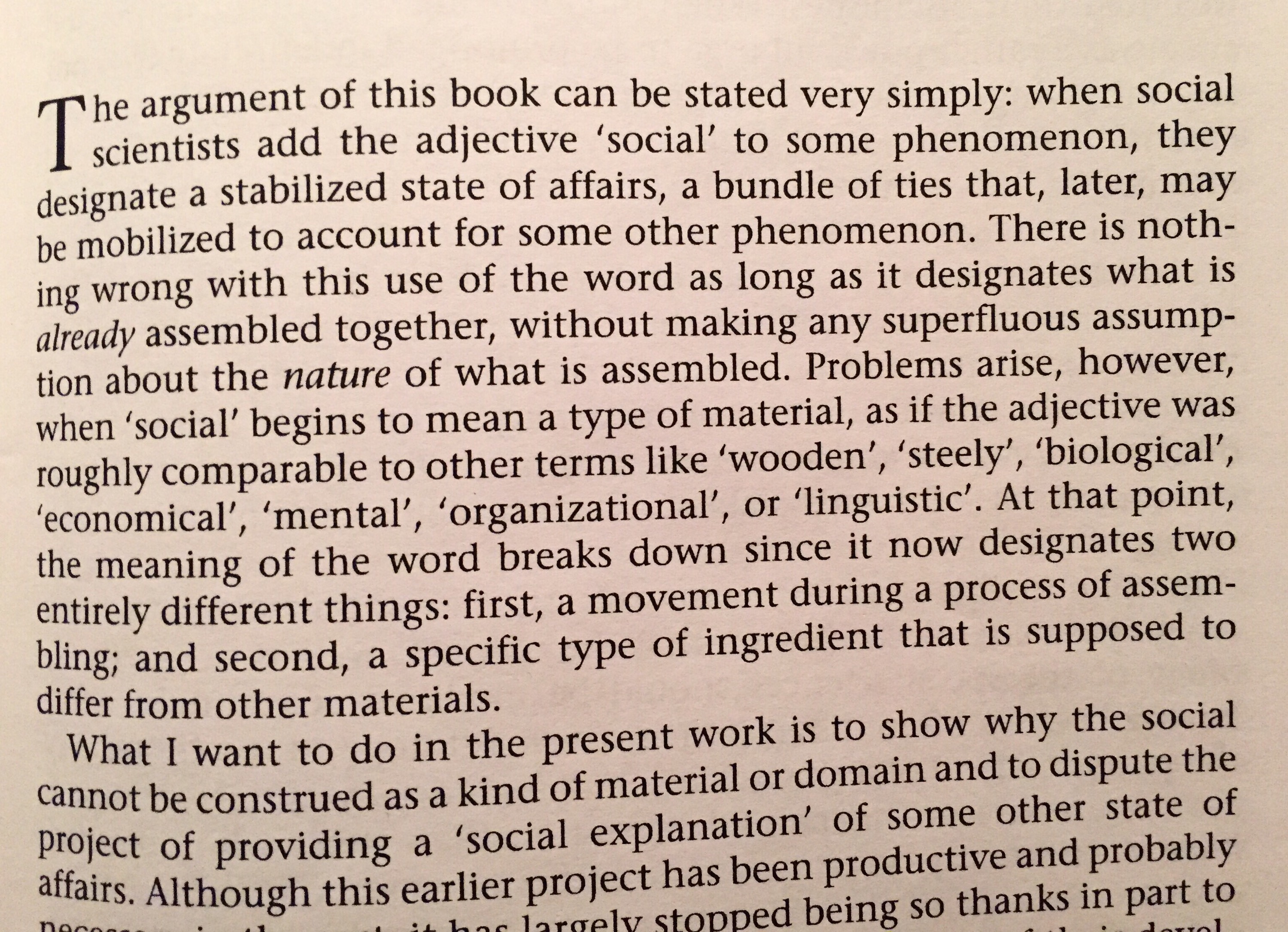
Academic writing seems designed to keep people like me out. Its dialect is a barrier constructed to exclude those who don’t have the socioeconomic, cultural and linguistic capital to penetrate it. Whose minds have resisted all attempts, external and internal, to be moulded into a narrowly specific way of absorbing knowledge. Read this, we are told. The onus is on us to figure out how. We are at a disadvantage from literally page one.

It smells like bullshit, like there’s something not quite fair happening. But it feels like personal failure.

Sometimes I think maybe grad school is secretly just an insane don’t-ask-don’t-tell circus. Surely no one actually does all the readings? It seems impossible. I can’t make my brain slow down enough to grasp the words on these pages when they’re so incredibly dense and meandering and nonspecific and abstract. If there’s no narrative, no examples, no stories—I can’t follow it. I physically try to force myself, and I fail over and over again.

Then, the depression sets in. The self-loathing.

My relationship to the concept of disability is ambivalent. I certainly feel disabled when I’m trying to read, but identifying as such given all my objective advantages feels like appropriation somehow. I wish I had some sort of sociopolitical solidarity to rally around to argue why Western academic social science writing is exclusionary to people like me despite the fact that I was shaped entirely within it, the way it clearly is to people from other cultures and backgrounds and epistemologies. I am cis and white and middle-class, I am ostensibly who academia was designed for. This place is supposed to feel like second nature to me, I am told. But my type of people—those of us with reading disabilities, ADHD, or just those who process differently—can’t absorb information in the way everyone else around us seems to be able to. But I don’t know who my people are. I don’t know who else to rally to solidarity. We are invisible. We are weeded out early. We are not common in this line of work by default. All I have is a diagnosis that I don’t even fully subscribe to, but whose necessity becomes starkly clear whenever I stop taking the meds. But how can you medicalize a way of thinking and call it a ‘disorder’? I am not disordered. This pedagogy is disordered.

When an otherwise functional, stable, intelligent person has to be medicated to succeed within a system, there’s something wrong with the system.

Hello Foucault. It’s nice to meet you, I’ve heard so many wonderful things. I like your glasses, and also your scathing indictment of modern carceral systems. Listen, I have some questions for you. If your ideas are so necessary, so revolutionary, why are they so difficult for us, the intellectual proletariat, to grasp through your writing? Why are you getting away with helping to perpetuate the very structures of exclusion and power that you rail against? You are complicit in their maintenance and silent about that irony. Explain yourself.

I keep hearing people say, “oh, it’s worth it once you slog through [X impenetrable author] for the brilliance.” And yes, I have found that to be the case for some authors. But look, some of us just don’t have the fucking time. I’m not saying I’m too busy doing other things. I’m a student, this is my job. All I do is read, and I try very hard to slog through these authors every single day. I’m saying I literally cannot physically read fast enough in a given allotted time to properly digest an entire book by those impenetrable authors. Or even most of it. Or half. The time-spent-to-intellectual-benefit ratio is completely skewed for this type of dense, convoluted writing. I can learn so much more from a podcast or documentary or narrative ethnography about a similar topic. Hell, in terms of time spent relative to benefits, I’ve absorbed a lot more from following Black, Indigenous and decolonial feminist anthropologists on Twitter than from trying and failing to read Donna Haraway.

So yeah. Maybe academia isn’t for me.

Except… I’m here somehow. They let me into a top-tier anthropology PhD program with full funding. I have a Master’s degree; I’ve been told my thesis was good, very good even. I’ve made it here despite ignoring all the Big-Cheese Social Theorists and relying entirely on the little guys, the Comprehensibles, the ones I can and do read, who mix theory in with stories–Bourgois, Agar, Moore, Singer, Garcia. What does it mean? Am I a fraud or are all those French sociologists frauds?

I’ve swum around them, these giant mysterious intellectual whales in a sea of friendly little ethnographer fish. Most of the fish know the whales’ songs, and at their register I can actually hear them. So fuck the whales, I think. I don’t need them. I’m a product of the Internet age. Wikipedia and YouTube have been my shortcuts through a world of writing I can’t penetrate to crack open the sweet sticky centre of the ideas inside that writing, which in the end are all that matter. All along, there’s an uneasy feeling I can’t shake that this isn’t right, that I’m missing something, that I’m cheating. That my inabilities, my disability, my patched-together and selective reading history will catch up with me someday. That I’ll be exposed for the illiterate goon I am and unceremoniously booted out of this discipline I love so much.

And yet, somehow, I seem to get by. I get good grades, I’ve been told that I express my ideas coherently in classes and am an above-average public speaker, even if I don’t quite believe it. People regularly tell me they like my work and my public outreach (blog posts and Twitter) has been very rewarding. I love everything else about grad school and about anthropology–research, teaching, listening, learning, thinking, experiencing. The stuff I can read, I am absolutely fascinated by. I’ve gotten funding and scholarships–I am being given money to think and write about stuff. I feel like I have things to say, a perspective that would benefit from being heard in my discipline. I have concrete things to point to when I’m feeling particularly useless.

But none of this makes me feel any better when I’m staring at words swimming on a page. Instead I walk endlessly back and forth on a scale between self-hatred and bitter rage at the people I’m reading.

Right now, for example, I need to write a response paper about a very famous book by a very famous man named Bruno Latour. I don’t understand the first fucking paragraph and that fact is all I want to talk about:

…For real? Is this a joke? Are we really all just gonna pretend that this kind of writing is an ACCEPTABLE WAY TO COMMUNICATE?

My internal thought process while reading goes something like this:

Okay, stating something simply, I like it, what’s next… Okay so I had to read the next couple sentences five times each because my brain kept showing me pictures of antique boats and my dad when he had a moustache and what I had for breakfast and Jon Stewart dressed as Donald Trump all set to the tune of that Talib Kweli song I can’t get out of my head mixed with the humming from my computer, but eventually I got there… Wait, hang on now. Slow down there compadre. What do you mean by ‘material’? You haven’t quite defined that and the way you seem to be using it in a way is diverging from my own understanding of the potential uses of that word and so I’m already lost. No, don’t try to blame the translator. I’m going through the repertoire of what you might mean by ‘material’ and nothing seems to quite make it work. I am also not familiar with a world in which the word ‘social’ can be productively equated with the word ‘wooden’ or ‘steely.’ It is not because I lack imagination. It is because you lack communication skills. Am I supposed to just buy this and move on? Why should I let you get away with this shit? Convince me. I am a skeptic. You are not winning me over with this attitude. …Or maybe I really am not cut out for this. I don’t know. Why can’t I remember more than the first two lines of this Talib Kweli song? Back to Latour. Focus. Wait, now it’s a ‘movement’? When did that happen? ‘Ingredient’? What? WHAT ARE YOU TALKING ABOUT?! I hear your ideas are important, what are they?! Give me your secrets, Latour! I want to understand! TALIB WILL YOU PLEASE LEAVE ME ALONE FOR FIVE MINUTES I’M TRYING TO CONCENTRATE!

Yeah. That’s paragraph one.

I’m supposed to read 140 pages.

I don’t know. Maybe I really don’t belong here. Or maybe you can get a PhD with Google and reflexive feminist ethnography and theory-by-proxy. Maybe the calls for valuing clear, jargon-free writing in academia will become something more than lip service in time to save me. Maybe all those intelligible, narrative-oriented authors I can actually read are on the rise, and they will revolt and overthrow the opaque obfuscatocracy and take over, freeing us lowly idiots from our intellectual subjugation. My supervisor is one of those legible authors, that’s for damn sure. She knows how to write. I devoured her book in three days because she has enough respect for her audience to tell a story while she analyses. Why isn’t she the head of [whatever fancy French program somewhere that Latour sits on top of in a building that will be named after him someday, drinking wine and laughing at us peasants with brain disorders as we struggle to comprehend his revered words]?

Sigh.

What can I do? I’m far too obsessive and determined to just convince myself that I don’t need the big whales at all. If I haven’t given up now, it’s not going to happen.

So. I put on some Talib Kweli, drink some water, and steel myself. On to paragraph two.


Note: I receive more emails and messages about this post than all my other writing combined. I love hearing from other students who relate to this experience! It’s clearly a systemic problem. However, if you message me and I don’t reply, I’m sorry, I get overwhelmed–and now that I’m a full-time mom AND PhD student, my ability to respond to messages has been all but wiped out. But please know that I hear you and value you. You aren’t alone. You are amazing for getting as far as you have. Believe me when I say this: it’s not you, it’s them. ❤


If you like my writing, please consider supporting me on Patreon, or sending some diapers for my baby from my Amazon list 🙂 I’m a low-income grad student and new mom trying to fight against the devastation of the Drug War–every little bit helps.

Find me on Twitter ranting about drug policy, criminal justice reform, anti-capitalism, psychedelics and anthropology: @HilaryAgro

Why abstinence-only drug education doesn’t work—in fact, it backfires spectacularly.

I talked to a lot of middle-class recreational drug users for my research. None of them had any idea when they were younger that they’d end up dropping acid on a regular basis when they became successful adults. Very few of them grew up in explicitly drug-positive environments, or even around healthy drug using behaviours. Some, in fact, experienced trauma caused by family alcoholism. (One person, Brad, who did grow up with parents who used recreational drugs, actually ended up adopting a teetotalling stance until age 30 as his form of rebellion1: “My parents were really disappointed. They genuinely were like, ‘Brad we’re really worried about you, you’re not gonna try drugs?'”)

Everyone I talked to remembered being taught anti-drug messages in school, and many were staunchly against drug use themselves as teenagers and young adults.

Dave: I had basically not even smoked weed at that point in my life. The only thing I’d ever done was drink alcohol. I was like, OK, I’ll have a drink, but like, I will not do drugs. I’m not going to throw my life away.

Adam: I was one of those people who years ago, I would have told you, no, I would never do those drugs, drugs are bad, drugs kill people.

So why, then, did they change their minds and start experimenting with consciousness alteration?

2016-03-20 20.37.00

Everything is fair game for an anthropologist’s office. You should see my hilarious collection of Far Side comics.

There was a really interesting pattern that came up in discussions of this topic. Without exception, every time I asked a person if they remembered anti-drug education in school, I would be met with the same reaction: a smile and a laugh. They would reminisce on how ridiculous scare tactics are as an educational strategy, chuckling as they remembered advertisements cracking brain-eggs into a frying pan or portraying the average drug user as a person with, as Ella put it, “your teeth falling out, skin all scaly and whatnot”. (“I actually watch those ads on YouTube sometimes because I just think they’re funny,” said Mandy.) They really are pretty funny. I have a “Reefer Madness” poster in my office, partly as a reminder of the messed-up, racist origins of North American drug policy and how that “Danger Will Robinson” paradigm continues today, and partly because it’s hilarious. When drug users laugh at this kind of scare tactic, the laughter comes not only from the ironic awareness that anti-drug education clearly did not work for them, but from the knowledge of how incredibly sensationalized and counterproductive it is in general.

The funniest part is this: Often, drug users talk about how, after being bombarded by frightening images of the worst possible effects of drug use, those internalized messages would actually backfire and have the exact opposite effect of their intention when they ended up trying illegal drugs for the first time. When none of the doomsday predictions come true after their first few times, users are left questioning the accuracy of all of the narratives they’d been given about drugs—including important ones about actual potential dangers.

Eleanor: They do all these anti-drug campaigns, and then you like, smoke weed for the first time. And then you’re like, oh it wasn’t even bad, and you’re like, OK now they’re lying.

Ad-2

Because “You’ll probably dance a lot, hug all your friends and then maybe have a light headache in the morning” isn’t going to terrify the youth.

The only narratives about drug use offered in an educational context are negative and completely over-the-top. When these narratives fail to prevent use, they’re promptly rejected as incongruent with the actual, real experience of being high. A lot of people are underwhelmed, even, after all the drama and hype around illegal drugs. (Fun fact: Your odds of seeing flying purple elephants on a starter dose of magic mushrooms are pretty low.)

Bobby is a 30-year-old raver from Toronto with an impeccable memory and a sweet disposition. He told me about how, when he was just starting to explore the scene, the stigma he had associated with drug users due to educational scare tactics was challenged when he found out that a good friend of his used illegal drugs. This change in perspective in turn caused him to decide to try them himself.

Bobby: I thought about it for a while before I decided to actually do it. And really the main reason I did it was, my best friend at the time—who I went to high school with and spent most of my time around at that time—him and I started going out, he kind of pulled me into the club scene with him. And then, I didn’t even realize it at the time until after a few months, I somehow found out that he’d been doing ecstasy the whole time and I never even knew about it.

In coming to learn that, that’s when I realized, oh okay, maybe drugs aren’t so bad and evil like I was taught, you know. Like as a kid, that’s what we were all taught. I expected this big change in someone and they’d just turn into this person, you know, this evil person, and I didn’t see that, so I was actually kind of shocked and surprised, like really? I didn’t believe him, and he said ‘yeah, I’m on it right now’. And I said oh, okay, well, what does it feel like? And he started telling me more, and I guess gears started turning in my head, and I got curious about it.

And I did a bit of reading and stuff, you know, I Googled it, just to learn some more information, in order to make an informed decision, I guess. So then, yeah, on New Year’s I decided that would be the first time to do it, I waited long enough. So that was the first street drug that I took.

meth

Drug negativity and sex negativity all in one fear-mongering package! Two stigmas for the price of one!

However, from I think age 14 or 15 I was medicated with Ritalin and then Concerta and then Dexedrine. So I guess I had already established some sort of ongoing drug usage.2

But then, what is there to replace those scary life-ruining narratives with? If they’re wrong about pot or ecstasy, what other lies have they told? What else is out there? Curious, bright-eyed little budding drug users are left with nothing to guide them except information from other users and their own personal experimentation. And that’s where problems start. Unchecked experimentation without informed guidelines and boundaries is the main source of bad drug experiences, especially when constrained by access only to unregulated substances (looking at you, prohibition. Man you are just the absolute worst).

Without being armed with any sort of accurate, balanced information about drugs, safe usage or harm reduction, inquisitive experimenters are left to find out for themselves about harms and benefits, relying on their peers and on their own process of trial-and-error to discover a more rounded picture of the world of psychoactive substances. And since not everyone knows about Erowid, you can imagine what kind of ridiculously preventable crap can happen when ‘figuring it out as you go along’ is how it’s done. “Oops, okay, so apparently you shouldn’t re-dose GHB if it’s been less than an hour since your first dose. Too bad I found that out the hard way, by puking on my friend’s shoes and passing out in the middle of a Bassnectar concert. Would have been nice to know beforehand.”

This trial-and-error is a process that often causes damages that could have been be easily avoided had they had access to balanced information about drugs in the first place, framed by a critical-thinking orientation and informed by attention paid to all aspects of drugs’ place in human life: good, bad and neutral. It also—this is where we get into the really controversial stuff—might be preventing a lot of people from experiencing significant benefits from some drugs, especially psychedelics and MDMA.

maxresdefault

Don’t do drugs, k gotcha. I can still get wasted on jager though, right? Alcohol’s not a drug.

Scare tactics might prevent some teenagers from trying psychoactive substances, but they leave those who do end up trying them woefully unprepared. Sound familiar? It’s because we’ve already accepted that abstinence-only education is a gigantic, steaming pile of failure when it comes to sex. Sex is an unavoidable part of life, teenagers included, despite what the puritans would like to believe. But guess what–today, right now, in our culture, drugs are an unavoidable part of life too. The odds are extremely good that you’re under the influence of a drug right now. My guess would be caffeine, especially if it’s morning when you’re reading this. Maybe it’s the evening, and you were sipping a glass of wine as you scrolled around Facebook and saw this post. Only you know what’s in your medicine cabinet. Drugs are such a normal part of life that we barely even remember the fact that most of us take them all the time.

Ignoring this fact is either a significant oversight in health education, or a conscious choice to leave those dirty, deviant experimenters who are curious about drugs to fend for themselves. This might make sense, in some cold, heartless neoliberal way, if human beings didn’t have a pretty clear universal desire to both alter our consciousness and experience pleasure. Either we find a way to get rid of that desire (HAH), or we need to acknowledge reality and have a conversation about what to do next.

“The reluctance to acknowledge research findings which show that experimental drug use is a normal part of adolescent development and that it may in fact improve psychological health, prevents genuine reform of abstinence-based drug education” (Keane 2003:229).

Is it time for education based on moderation and information, then, instead of prohibition and abstinence? This is the stance that public education in Canada takes on sex education, and we know it works far better than abstinence-only education. The idea of allowing young people to make their own, even informed, choices about their bodies is one that doesn’t sit well with many policymakers or parents. It makes them grimace and squirm and protest. However, the fact is that these choices are being made by young people regardless of the lack of information they have to making those choices with. The current strategy of leaving youth uninformed or even deliberately misinformed in the hopes that they abstain from drugs (many of which aren’t even harmful unless they’re consumed improperly) is, quite frankly, immoral.

Let’s treat teenagers with some respect, instead of thinking that lying to them is going to protect them from the world.

Please share this, or start a conversation, with anyone you know who is reasonable enough to accept that abstinence-only sex education doesn’t work, but might not have realized that about drug education too.


If you like my writing, please consider supporting me on Patreon, or sending some diapers for my baby from my Amazon list 🙂 I’m a low-income grad student and new mom trying to fight against the devastation of the Drug War—every little bit helps.

Find me on Twitter ranting about drug policy, criminal justice reform, anti-capitalism, psychedelics and anthropology: @HilaryAgro


1 A longer interview excerpt from that story, because it’s hilarious:

Brad: My parents were rock and rollers. My rebellion was spreadsheets, computers and math, and you know, getting a job.
Hilary: [Laughs]
Brad: I got a mortgage at 21, and I didn’t even have a beer until I was 30.
Hilary: Were your parents disappointed?
Brad: They were really disappointed. They genuinely were like, “Brad we’re really worried about you, you’re not gonna try drugs?”
Hilary: [Laughing] Seriously?
Brad: Yeah. And that’s because I was on the path to becoming a miserable square. Like, didn’t live. Didn’t party. Didn’t have fun. And that’s, I mean, I was a workaholic, through my twenties. That’s all I did. So I’m kind of going through my twenties now. Kind of backwards.

2 Note that Bobby’s last comment is a great example of the legal/illegal conflation of what is or is not considered a ‘drug’.


The intangible narcotic: What does ‘vibe’ mean, really?

There’s a term that comes up pretty frequently when talking about electronic music events. A search within my interviews (excepts from which are quoted here) and field notes found it mentioned 88 times. Everyone knows what it means, but no one knows exactly how to define it.

Daniel: Vibe is almost a different narcotic of its own. Vibe is… it’s intangible, you can’t touch it, you can only feel it, sense it.

It’s a word I found myself using and implicitly understanding long before I began to think about what it really means. The vibe of, or at, an event can be all levels and qualifiers of ‘great’ and ‘amazing’, or it can be chill, or it can be strange, aggressive, sketchy, even hostile. (Yeah I know. Describing this explicitly is awkward already. Bear with me, we’ll wince together.)

Sunnyside 2015-07-12_169

On the dance floor people move from one area to another, soaking up as many different sensations and feelings as they can. I say sensations because each area has its own vibe, or energy, that can be felt. Participants have described this vibe primarily as a subtle form of communication among people. It is both body language and an intangible energy that is given off by people and can be felt by others. – Brian Rill (2010)

As usual when I’m trying to unpack terms we all take for granted in the rave scene, I feel a little silly doing it. (Trying to define, in academic language, what exactly a ‘bro’ is was one of the funniest things I’ve had to do while writing up my research.) Pulling apart the concept of ‘vibe’ felt like deconstructing a joke – talking about it explicitly ruins what makes it special; its very existence is made of an implicit shared understanding of a subjective experience. The word started to lose all meaning, as it will soon for you if you keep reading this post.

But there was still something bugging me. Some important meaning hidden in the way people talk about it. It seems trivial, but it turns out that the vibe of an event indexes much more than it would appear.

Hilary: So you say the crowd is really important to you. Can you describe the kind of vibe that you enjoy?
Mandy: Um… Open-minded. Uh, I like weird people. [Laughs] Like, a diverse crowd, I think. I can tell when people are there for something other than the music. And then it kind of just ruins, like, the vibe.

Steven: All the frat boys were showing up and pissing on the trees, and it was just not the right community or vibe anymore.

Ali: You get a certain vibe when you go into places. Like, I don’t know, I’m a very intuitive person, I feel like I read people well, and I just know whether I’m like, in a safe place or not. [Laughs] It sounds so corny, but it’s true.

Veld 2015 (219)

What are the things that affect the vibe of an event? The décor, the lighting, the music, the attitude of the staff members (especially security), the size of the event, the theme (if any), the type of clothes people are wearing, the time of day or night, the type of drugs being consumed, and the age of attendees. But dwarfing all of these factors in its impact on the vibe is one key element. Pinpointing and exploring this element became an important focus of my research, as it underlies one of the main problems at raves, particularly the mainstream ones that young and inexperienced people are more likely to attend.

The first event I attended where the overall negative vibe began to stray into very uncomfortable territory due to this particular factor occurred late in July, and it’s a story which incidentally includes some good illustrations of harm reduction in practice. My partner Diego, our good friend Jake and I were at a techno event. Jake had taken three hits of acid, which had made him unusually chatty, though he was also feeling self-conscious and not fully able to articulate his thoughts.

“I’m going to rely on you guys tonight, ok? You’re my guides,” he told Diego and I. I told him he seemed to be keeping it together pretty well. “I have no baseline for what would be considered keeping it together right now,” he responded. I laughed and told him he was doing fine, trying to make sure he felt he had a basis of support for his trip.

The place was still pretty empty. Two girls were sitting on some flat leather seating around a low table in one of the corners. Since there was plenty of room, and my legs were still sore from an event the night before, I went to sit down. The girls whispered to each other and stared at me. I ignored them, but suspecting what was going on, gave them the courtesy of exaggeratedly rubbing my knees and back for effect. Finally one of them walked over.

“This is a private booth,” she said.2015-06-14 00.13.17

“Oh,” I responded, looking at the empty seats. I briefly considered playing dumb and making her spell it out even more for me, but decided on being straightforward. “Can I just sit here for a few minutes?”

She looked unhappy, but was too shocked at my shameless impertinence to argue. “I guess so.”

I could tell she wasn’t going to be able to enjoy herself until I left. Diego, highly unimpressed with her attitude, told me to take as much time as I needed. Her indignance made me think about the purely relative basis of wealth and status. How could she enjoy the exclusivity of having paid for a private booth if it was no longer private? A bottle-service booth so empty that non-VIPs could accidentally wander in and sit down throws the arbitrary and pretentious nature of these booths in their occupants’ face and devalues the experience completely. Despite feeling bad for the type of person whose feathers could become so ruffled at such an absurdist challenge to their power, my own distaste for being asked to leave an empty seat that could fit five people kept me in place. Wanting very different things from the same event, we were both clear examples of ruining the vibe for one another, for very different reasons.

After a few minutes—enough time to preserve my Marxist dignity without causing her glares of annoyance to turn into sad, sad rage—we went to dance. The music was excellent, but I could already tell that the general feeling of this event was not to my taste. I found that I could not face the DJ, as a blinding strobe light was positioned directly above his head. All I could hear was the incredibly loud bass, which is apparently an acquired taste, as I frequently disagree with my musical connoiseur friends Brad and Daniel on the value of being able to hear anything but said bass. The smoke machine was so intense and the venue so small that when I opened the door to the bathroom I actually wondered if there was a separate smoke machine in there as well. Regardless, none of these factors were all that bad, and the venue was unique, so it seemed worth staying.

2015-08-23 01.23.51

With all this stimulation, however, Jake began to feel somewhat overwhelmed. I took him outside for some air and gave him a water bottle that I’d been filling up in the bathroom. I went back inside and wrote down in my fieldnotes to “Google ‘smoke machine toxicity’” which made me laugh at how inadequate the conception of ‘risk’ in the rave scene really is, as I’m considered to be a risk taker. Soon, however, I felt a tap on my shoulder. Jake had returned, looking anxious. He asked me to come help him outside.

In the smoking area, I found out that two young men were accusing him of drugging their friend, who I’ll call Pale Sweat-Face. Seeing that Pale Sweat-Face looked sweaty and pale, Jake had offered him some of the water I’d given him, which they were convinced for some reason contained GHB as well. Apparently, Jake, in his acid-influenced reasoning that communication barriers were all that stood in the way of understanding, reconciliation and friendship, had tried to use meticulous honesty and tell them that since the water had been out of his possession for a few minutes while I filled it up in the bathroom, he couldn’t technically guarantee there was nothing in it, but that he trusted the person who filled it up. I swore to them that it was just water, and that of course none of us would give someone GHB without knowing. I could feel the eyes of the security guard watching us. Pale Sweat-Face had clearly taken something; he looked disoriented and woozy. I was more concerned about Jake, however; this type of conflict can easily set off a bad trip for a person on psychedelics. I knew Jake fairly well and had seen him handle LSD capably before, but three hits is a sizeable amount for anyone, and bad trips can be a terrifying experience.

2015-08-16 04.22.03

I couldn’t place something about the attitude of the young men, however. I couldn’t tell if they were accusing us because they actually thought we did it, or because they were choosing to be intentionally antagonistic and argumentative, something I’d rarely seen in the rave scene but have definitely witnessed from intoxicated men and women many times at ‘regular’ bars. When I realised the latter might be the case, I stopped trying to convince them we’d done nothing, grabbed Jake and went back inside.

We attempted to shake off the unpleasantness by dancing. We reassured a frazzled Jake, still peaking on LSD, that he’d done nothing wrong; he was just trying to be nice and share water with someone who looked like they needed it. He shook his head and gave me a hug. “Reality is so complicated right now,” he muttered.

We were just starting to enjoy ourselves again when a tall blonde man in his early twenties approached me. “Do you want to dance?” He placed his hand on the small of my back.

Being a woman in the rave scene, I had quickly become adept at conveying the body language of thanks, that’s enough, and that is all the interaction we will be having tonight. It is an essential skill and one that all women who participate in nightlife develop in some way. Fending off unwanted advances is unfortunately a standard part and parcel of the experience of women at many of these events. When body language fails, things get even more awkward and you’re forced to try words instead. Words are tough when you’re socialized to never be direct and assertive, though, so these little messy situations happen neverendingly, and they always suck.

2015-06-14 00.39.47

I began to run through the familiar rolodex of conflicting emotional responses to the blonde guy’s question. The heart of the conflict, which most women are intimately familiar with and which is being challenged in contemporary feminist activism, is the perceived need to be gentle in declining a man’s advances, and appreciative of their supposed inherently complimentary nature. How do I say no without being rude? It’s an exhausting and ridiculous question women find themselves asking over and over. We should be asking an entirely different one, but I won’t get into that right now.

“Sure, if you’re ok that my husband is right there,” is what I chose to respond to the blonde guy. The idea behind this approach was that, in the unlikely case that he still didn’t lose interest upon hearing this, it would indicate that he was genuinely just interested in dancing briefly and nothing more, which would be fine.

But Jake and Diego were already intervening on my behalf. Diego put his arm around me and Jake asked the man to back off. Knowing them, I am sure this kind of overprotectiveness would not have happened if we had not already felt an aggressive, unwelcome vibe from the event. I talk to strangers all the time at these things, I am doing research after all. But the whole situation, it seemed, just smelled wrong to them. We hadn’t been meeting friendly, smiling, open people at this place. Why should this person be any different?

Yet I felt no better for not being allowed to deal with the situation on my own. When I told them this, Jake mused reflectively about his instinctive drive to intervene. “Maybe I’m more protective of you because you’re like one of my herd.”

The whole thing felt gross. We eventually decided that the music was not good enough to make up for the aggressive vibe of the event, and decided to go to the after-hours club to keep dancing and attempt to salvage the night (and Jake’s trip). As we turned the corner outside on the street, we saw a group of four young men. One was the blonde who had asked me to dance. The other three were the same men with the ambiguously aloof and hostile attitudes who had sent Jake’s trip spiraling into a bad direction by accusing him of giving one of them GHB. Things clicked into place. I hadn’t even realised they were in the same group. They’d apparently been kicked out because of their friend’s drugged-out behaviour.

Despite having had more than enough of all four of them, I couldn’t fight the mama hen instinct in me to check on Pale Sweat-Face and make sure he’d be OK. I tried to convince them once more that I hadn’t put GHB in the water by showing them one of the business cards I made to give to people interested in my research. “I work in harm reduction, I’m the last person who would drug someone.”

One guy examined my card and looked up at me. “You’re not just being a bitch right now?”

We left.

2015-08-23 01.14.48-2

The real heart of the ‘vibe’ at an event isn’t the decor, or the venue, or the age of the attendees. Though of course it’s not the only factor (which I hope was made clear by the above narrative), by far the most important one seems to simply be the reason why the men are there. Are they there to dance and enjoy the music, or are they there for basically any other reason? If it’s the latter, it’s going to end up fucking up the night for some or all of the poor kiddos who just want to dance.

Vibe is basically summed up in how the men at an event behave. Towards each other, but particularly, of course (sigh) towards women. Either way, if people don’t feel safe, they won’t have fun. And the only real dangers at raves come not from something inherent in drug use, or from a risk of fires or some bullshit (looking at you, Toronto FD, couldja stop?), but from the unpredictable and self-reinforcing behaviour of some men.

There’s a dance version of Maslow’s hierarchy of needs (can we call it Agro’s hierarchy of rave needs? Cause I would totally love that to be my legacy), and not worrying about walking piles of aggression when you’re trying to party is right at the bottom. It’s foundational. Talking to people all along the gender spectrum, and digging into their thoughts about the vibe at their favourite (and least favourite) events, it became clear that the comfort and safety of women is the key factor that determines everything else. Right above safety is a lack of judgement from other people. We’re all at these things to get away from the constant social judgements we receive on a daily basis for being the weirdos we are, and play with the arbitrary rules and boundaries about what to wear, say and do that we’re forced to follow in everyday life. When people say, “the vibe of that place is awesome”, what they’re really saying is, “I’m a woman and nobody grinded their dick into my hip at that place even though I was wearing only my bra” and “I’m a guy and I felt like I could hug my male friends without getting hit by a stinky wave of judgemental testosterone from those unsmiling dudes in flat-brimmed hats in the corner”.

Ahhh, bros.

Happy International Women’s Day.

2015-08-23 04.32.12

As always, names have been changed and if you think I’m right, wrong or completely full of shit, feel free to let me know.


If you like my writing, please consider supporting me on Patreon, or sending some diapers for my baby from my Amazon list 🙂 I’m a low-income grad student and new mom trying to fight against the devastation of the Drug War—every little bit helps.

Find me on Twitter ranting about drug policy, criminal justice reform, anti-capitalism, psychedelics and anthropology: @HilaryAgro

Drugs are… good? No, that can’t be right. Can it?

Like most academics, I’m obsessive. I spend a lot of my free time doing searches for new research on recreational drug use. I do this partly because there’s a big gap in drug use and policy research that I’m waiting for someone to fill, and I can’t just let it go. I keep checking to see if someone’s addressed it yet, unable to seriously consider that I might have to be the one to fill it. Surely I’m just not looking hard enough. It must be hiding under some ethnographic couch cushion that I just haven’t lifted up yet.

You see, the perspectives and opinions that I have found in the field of social science drug research vary. There are different people coming from different backgrounds believing and arguing for different things. But almost all of the existing literature, both popular and academic, on illegal drug use is in agreement about one key assumption. It’s an unquestioned assumption which drives almost all research on drug users, yet drug users themselves laugh at it for its simplicity and ignorance:

The assumption that illegal drugs are inherently bad. All of them.

Can't it be both true and not true?

Can’t it be both true and not true?

Bad for individuals, bad for society. They are a scourge on humanity, they destroy lives and, boiled down to the essentials, are just a (complicated) problem to be solved. Some say we desperately need to find a way to get rid of all drugs. Some advocate for harm reduction, saying, well, drugs suck but we’re not going to get rid of them, so let’s at least reduce the harm they cause (while we figure out how to get rid of them). Some tout their potential medical benefits—man, have you been reading the news? Marijuana cures EVERYTHING!—but in doing so they maintain subservience to a strictly controlled biomedical framework as the only acceptable place for drugs that aren’t alcohol.

Probably thanks to where funding comes from, there just aren’t many researchers raising their hands from the back of the class to timidly propose that maybe, just maybe, we should question that assumption before we run around trying to solve problems. Because if our assumption is wrong, well, shit. Then the problem might be entirely different from what we think it is. There may not even be a problem.

Now, if you’ve ever actually worked with drug addicts, or been one, you may be about to angrily call me a naive idiot for implying that there’s no problem. Yes, some illegal drugs definitely cause problems. Huge ones.1 We’re all pretty aware of that. On the other hand, if you’ve ever been around responsible drug users, or been one yourself2, you may feel relieved to see this issue even acknowledged. Because the difference between problematic use or addiction and truly unproblematic recreational drug use, as muddled and complicated as the Venn diagram between the two may be, is what’s missing from most conversations about illegal drug users. The fact that its very existence is in question is what is wrong with the conversation on drug policy. The consistent denial of shades of grey is unforgivably ignorant after so many years.

Where are the social scientists critiquing the ‘all drugs are bad’ assumption?

They took drugs, they hugged, they laughed, they went home to their jobs and nothing bad happened. Why do researchers pretend these people don't exist?

They took drugs, they hugged, they laughed, they went home to their jobs and nothing bad happened. Why do researchers pretend these people don’t exist?

I have struggled to find existing research that really reflects the kind of work I’m currently doing. Everything comes from a problem-based orientation. That was my focus at the start, having drank the social-epidemiology Kool-Aid, but in keeping with the tradition of ethnographic research, I maintained no particular attachment to my original orientation and spent much of my time in the field questioning my own assumptions. Thus the conclusions I’m starting to reach from my fieldwork are somewhat unexpected, which is fairly common in anthropology. But because of it I’m at a loss to find many other researchers who think about drug use in the same way. Laymen, oh sure, plenty. But published research, not so much. (One can assume that this is heavily due to preexisting and self-perpetuating biases in funding sources. Paradigms don’t go down without a fight, especially those that are so usefully attached to marginalizing certain handy scapegoat populations.)

Some researchers have come close. Geoffrey Hunt, David Moore and others remind us to not leave out the concept of pleasure from analyses of drug use, but this is still a recommendation in service of the goal of use-reduction. I’ve also, of course, found research that challenges the mainstream status quo in other ways; Philippe Bourgois and Michael Agar are two obvious big names who’ve had incredibly profound effects on the study of addicted populations: “You can’t understand and explain an intoxicated corner of a society without a critique of the larger society that produced the historical conditions that make that corner the place that it is,” said Agar in his unbelievably entertaining memoir of a lifetime of drug policy research.

The goal I set out with in my research on ‘party drugs’ in the rave scene was based on that important idea, to figure out solutions through a holistic understanding of a drug-abusing population. But Bourgois and Agar study populations of drug users that generally, when it comes down to it, really hate the drugs that they use. They have good reason to. The difference in my research is that the underlying assumption that drug use is always a social problem is flawed when it comes to groups that may actually be using, and even benefiting from, recreational drugs in ways that don’t negatively affect them or the people around them.

What if non-addicted drug users really, just… kinda want their drug use to be left alone?

What if the problems stemming directly from their drug use are fairly minimal, and the benefits significant? What if most of the dangers are actually caused by the laws put in place to supposedly protect them?

If my guiding question is “Gee, why are all these people doing such a bad thing as consuming party drugs” (which, without the explicit value judgment, was indeed one of my research questions3), I’m asking the wrong question—if I’m asking it because I want to get them to stop, not because I really want to know the answer and am open to whatever it is. Taking for granted the same assumptions underlying most of the preexisting research, and asking “Why are these particular people using drugs?” only as a means of understanding enough to further the specific goal of a particular agenda—such as harm reduction or use prevention—my ears might not be open to hearing the actual answer, rather than an answer that confirms those same original assumptions. The actual answer might challenge those assumptions. The actual answer could be, for some people: Because there are few downsides and tons of upsides, and they know it.

I probably just haven’t looked hard enough for someone else who’s talked about this though. So does anyone know of published social science research on drug use that isn’t grounded in problem-based assumptions? Arriving at an answer that challenges the status quo is both exhilarating and terrifying, but since I’m only a grad student, and it’s a topic absolutely riddled with stigma, it leans more towards terrifying. So someone please point out the couch cushion that I’m overlooking so I can flip it over and see if there are any crumbs I can sweep up and cling onto to help prove I’m not crazy.

EDIT: I found one! It was published this year.

Notes

1Note that they are actually, in turn, only symptoms of deeper structural problems, usually socioeconomic in origin.

2And chances are you are one, because—surprise!—if you drink alcohol, you are a drug user. But fine, we’ll stick to illegal drugs.

3Even while I disagreed with the value judgement—I’ve always been a proponent of the positive aspects of illegal drug use—I got the sense that a subtext of detached Mr. Mackey-ness was necessary to appeal to those in charge of funding decisions and am only now realising that I’m going to have to openly challenge it, as career-destroying as it might be.


If you like my writing, please consider supporting me on Patreon, or sending some diapers for my baby from my Amazon list 🙂 I’m a low-income grad student and new mom trying to fight against the devastation of the Drug War—every little bit helps.

Find me on Twitter ranting about drug policy, criminal justice reform, anti-capitalism, psychedelics and anthropology: @HilaryAgro

“Drugs are bad,” he said, sipping his beer: Legality vs. social acceptability

I’ve found it highly interesting to hear drug users trash talk other drugs, even while they’re high on their own preferred substance. Gina* thinks that alcohol is the worst drug around, and only smokes pot. Albert drinks, and takes MDMA or coke whenever it’s offered, but he shakes his head when he sees his friends smoking cigarettes. They both think GHB is for idiots, and neither of them, of course, thinks that a drug’s legality has anything to do with its acceptability.

Judging other users doesn’t inherently make you a hypocrite, because not all drugs are created equal–I myself think crack is incredibly destructive and that weed is practically harmless, even though I don’t use either. But the opinions are just so strong on all sides that, just for fun (oh yes, this is indeed my idea of fun), I created a visual expression of the general spectrum of legal/illegal, acceptable/unacceptable drugs based on my interviews and fieldwork in the Toronto rave scene:

Perceptions of the social acceptability of party drugs versus their legality

Subjective perceptions of the social acceptability of party drugs versus their legality. (Click to embiggen.)

Having ecstasy, LSD, marijuana (for now), or cocaine on your person can get you thrown in jail. Alcohol, caffeine, and tobacco, you can consume to your little adult heart’s content. However, these drugs’ legal status doesn’t reflect how people view them in terms of their perceived morality.

There are ‘moral’, socially acceptable or legitimate, drugs, and there are immoral/unacceptable/illegitimate drugs. While many in the mainstream accept the status quo of conflating a drug’s legality with its acceptabilityI never get tired of hearing a drunk person say “I don’t use drugs!”, it kills me every timemost people and groups have their own personal categorizations of what substances are acceptable or unacceptable to consume. In particular, to those who choose to use both legal and illegal drugs, a drug’s morality by no means correlates with its legality. Just ask Gina and Albert.*

The reasons behind deeming a drug as socially or morally acceptable are complex, but they most often involve a combination of personal experience, family/peer group/media influence, perception of addictive potential, and cost/benefit analysis in terms of harms and pleasures. Right now I could still make a different graph for different age groups, levels of user experience, and what people say vs. what their behaviour actually indicates. I know that every single person has a different version of this in their own head, but I’m curious about what this graph would generally look like for where you live. Where would these drugs fall on the spectrum for your social group or city? Have you noticed differences based on music sub-genres?

Note: Check out the interesting discussion of this post on reddit, where I find out that I’m wrong about nitrous’ legal status, and also have to explain the concepts of subjectivity and perspective about fifty times.

Not my image. Google gave it to me. How duz I copyright law.Some notes:

  • This chart is a rough first version – it still needs some adjusting. (Well, it doesn’t need anything because it doesn’t even need to exist. But still.) But more importantly, my research is ethnographic, not scientific; this is all very unofficial, I just did it for fun and to help visualize a theme I’m working on.
  • Corrections: The “level of abuse potential” should say perceived level of abuse potential. Also, nitrous is not illegal in Canada.
  • The bottom left I have affectionately termed the “Boogeyman Corner” because those drugs are ironically still subject to the same stigma that, in the mainstream, equally affects these ravers’ preferred drugs.
  • Obviously, everything in existence has abuse potential, including all of these drugs. I took that fact as given when assigning levels of abuse potential as it would be pointless for every single one to have a lightning bolt.
  • The “legal” axis is less strictly defined. I sort of put things there based not only on whether or not they’re legal (which is a yes or no question) but on how restricted their use is, how close they are to potentially being legalized in the future, the degree of care I see people using to hide their use of each drug, the fear of potential law enforcement from users of each one, etc. Things like prescription drugs are hard to place because they’re technically legal but used recreationally (and thus illegally) by people at events. They should probably be on the illegal side but whatever.
  • So many different drugs fit into the Reseach Chemicals (RCs) category that it’s just a can of worms I didn’t feel like opening. Hence the generalized categorizations.
  • Most ravers have little or no experience with opiates, since they’re the least compatible with the main point of electronic music events, which is dancing.
  • The social acceptability of many of these (note the ones with a *) is context-dependent and very ambiguous (which makes them extra interesting!):
    • Alcohol, for example, tends to be the one that people both criticize and consume most frequently. It’s especially criticized in comparison to other recreational drugs, but still used more frequently than any other, mainly due to a) its wide availability and legal status, and b) the ability to easily and progressively manage dosage.
    • Cocaine is similarly badmouthed by some and loved by others (sometimes both at once from the same person). I could maybe even switch its place with ketamine.
    • GHB is very context-dependent in that it’s the drug that causes the most frequent overdoses, so people use the derogatory term “G’ed out” a lot, but using it responsibly is acceptable.
    • Mushrooms are considered perfectly acceptable in general, but most people say they wouldn’t feel comfortable using them at crowded music events.

*Gina and Albert are aggregate people I just invented to make a point. But they definitely represent the opinions of real people I’ve met.


If you like my writing, please consider supporting me on Patreon, or sending some diapers for my baby from my Amazon list 🙂 I’m a low-income grad student and new mom trying to fight against the devastation of the Drug War—every little bit helps.

Find me on Twitter ranting about drug policy, criminal justice reform, anti-capitalism, psychedelics and anthropology: @HilaryAgro