Big tents: Can we let liberals into the movement for liberation?

Liberals—defined as people with progressive social beliefs who generally support capitalism implicitly because they don’t know what it is or because they have a poor understanding of it, ie. those who believe “sexism and homophobia are bad but land ownership is good”—are not going to save us. No movement against fascism will ever succeed if it’s not led by the left, because fascism is capitalism in crisis. Yes, it is our job on the left to help people see this. No, we cannot sit back and let liberals call the shots.

But, can we let liberals into the movement for liberation? The question itself, though I see it discussed a lot, is misleading: in the end, no one is in charge. There’s no lineup with a broad-chested trans masc аntifа supersoldier holding a velvet rope making sure no one who’s ever said “well people taking advantage of welfare is a problem” gets in (believe me, I wish it were that easy). This is a decentralized, often organic movement. Libs are finding their way into it by being radicalized by what they’re seeing in their communities, thanks to the repulsive buffoons that run the American Gеstapο. And that’s great! That’s what we want! We should be excited by all the newly energized soccer moms and Formula 1 dads taking to the streets. But wait… They’re bringing with them some beliefs and practices that are counterproductive to the fight for liberation. Some have questions about trans women in sports, some believe that certain settler colonies have a right to exist. Not great! But also, inevitable, because we were all raised in a shitty, settler colonial system that kept us hidden from the truth of our interconnectedness at all costs.

The tent should be big. It has to be, in order to build enough working class power to challenge capitalism. But we must use this big tent to shelter people while we help them see that all our struggles are connected. Liberalism cannot be anything more than a temporary stepping stone that people go through in their journey towards anti-capitalism, guided by those who understand class, race, gender, and other intersections of oppression.

There are many critiques of the rigid purity politics on the left, where we put extremely strict ideological demands on others in order to be willing to work with them, and are quick to label anyone who doesn’t live up to our standards as problematic, sexist, racist etc, and thus not welcome in our revolution. Some of those critiques are in bad faith, coming from loud centrist political pundits who actually just want to browbeat the left into submission to make us vote for capitalist political candidates who will perform civility and throw our most vulnerable neighbours under the bus to hold onto the crumbling fantasy of peace that our white supremacist nations are built on. However, just because some of the critiques are in bad faith does not make it a non-issue. Demanding ideological purity is a problem on the left. And it’s because we don’t want to take on the responsibility of teaching and helping propagandized but well-meaning people. It’s hard and we’re tired, so instead we want people to show up already educated. That’s not a path to winning.

We don’t have enough conversations about who is going to take on the work of deprogramming well-meaning working class people who’ve been conned into prejudice. We don’t even like to admit that that work is necessary, because it’s scary to confront how complex and imperfect your average fellow human is. People can be really kind, and believe in the value and dignity of other humans, and also believe that “if you work hard you’ll succeed” or “things were fine before Тrump, he’s the problem,” both obviously false statements. Very few people are actually fixed in their beliefs and committed to their bigotry, but since that category of people provides an easy out from doing the work of helping them, we broadly lump everyone who’s remotely frustrating into that category, call it a day, and go rot in doomerism.

I do understand why people respond to those Big Tent “purity politics” critiques with “oh so you want us to let racists/transphobes into the movement,” because for a lot of liberal pundits who specialize in punching left, that essentially is what they want. They want to think of themselves as progressive, they want to be seen as one of the cool kids who’s against the status quo, but they also want to keep their cushy positions within the status quo. They want to have their cake and eat it too. They don’t understand that the climate crisis is coming for all of us, and they are stuck in a constructed reality of denial where they believe America, or Canada, or England, or wherever state they’re from that’s built on a foundation of genocide and upheld by militarized borders and imperialism abroad, is fundamentally good and all we need is the right people at the top of this house of cards and we can all go back to brunch. They don’t realize that the only reason they have positions of influence at all is that they’re useful idiots for the people in power.

So fuck that, obviously. But at the same time, when we zoom out on the purity politics issue and stop using labels as a way to dehumanize people… A broad working class movement is going to necessarily include people who haven’t deprogrammed all their prejudices.

You and I haven’t deprogrammed all of ours! How can we expect more of others than ourselves?

You likely have some fatphobia rattling around in there. Maybe some drug user stigma, some sanism, prejudice against children, probably lots of ableism. Almost certainly, unless you’re Indigenous or have been working HARD at decolonizing, you’ve got anthropocentrism.

You’re also still whole and valued. You are as essential to the movement for liberation as every other working class person. You’re a good person who cares, who was harmed and misled by the systems that hid these issues and others’ experiences from you. Just like the Resist lib who reveres the founding fathers or thinks we need cοps.

As someone who has been working for nearly two decades on building coalitions among different liberation-minded groups, and who wrote my PhD dissertation on this exact topic, it always feels very ironic and frustrating to see the impatience leftists have for some forms of ignorance and prejudice, while openly displaying others themselves. Sometimes literally at the same time! “That politician must be crazy/smoking crack.” “Put that person in prison for life!” Like, come on man, you’re killing me here.

But I understand that people are always doing their best, and the propaganda system is more well-funded than we can even imagine. That’s how good people are at heart and how oriented we naturally are towards each other; it takes billions of dollars and a vast, massive system to try to convince us otherwise, and it still hasn’t fully worked!

So we could all benefit from practicing way, way more humility and grace in movement-building work, and seeing others as propagandized and in need of guidance, rather than bad and deserving punishment/ostracism. If they mean well, help them do better.

Also, it’s highkey super useful to have pussy hat libs walking around calling themselves antifa. It takes the heat off of us! We need them muddying the waters of who the target for suppression should be!

So, what can we do?
If you do feel ready to do this deep, difficult, rewarding work of movement-building, here are my suggestions. But first, I want to express my gratitude to you, because it’s honestly REALLY fucking hard to push past the anger enough to do this. Most people are not resourced enough for it. I struggle with it all the time!

Identify which of your identities makes you best suited to talk to other people with that same identity. As much as it sucks, I have to talk to white people because they are more likely to listen to me than the Black and Indigenous people I have learned from. It’s a responsibility, but also an opportunity. Men, talk to other men. Straight people, talk to other heteros. Religious people, talk to others in your faith. Non-Indigenous people, talk to other settlers. Most of all, working class people, talk to each other about class issues! (Class is generally the most productive place to focus your efforts in my opinion, because it’s the great uniter, and the reason we were divided against each other by capitalists in the first place.)

Here are five resources I suggest to start with to build these communication and organizing skills. None are perfect, all are just tools in a toolbox. Pick whichever interests you, leave anything you don’t feel aligned with.

1) Nonviolent communication training: an incredibly resource for learning how to talk to and connect with people using a non-authoritarian approach. (This is where I learned to identify how often people interpret suggestions and requests as demands, a quick way to see how unresolved trauma functions to hamstring our movements.)
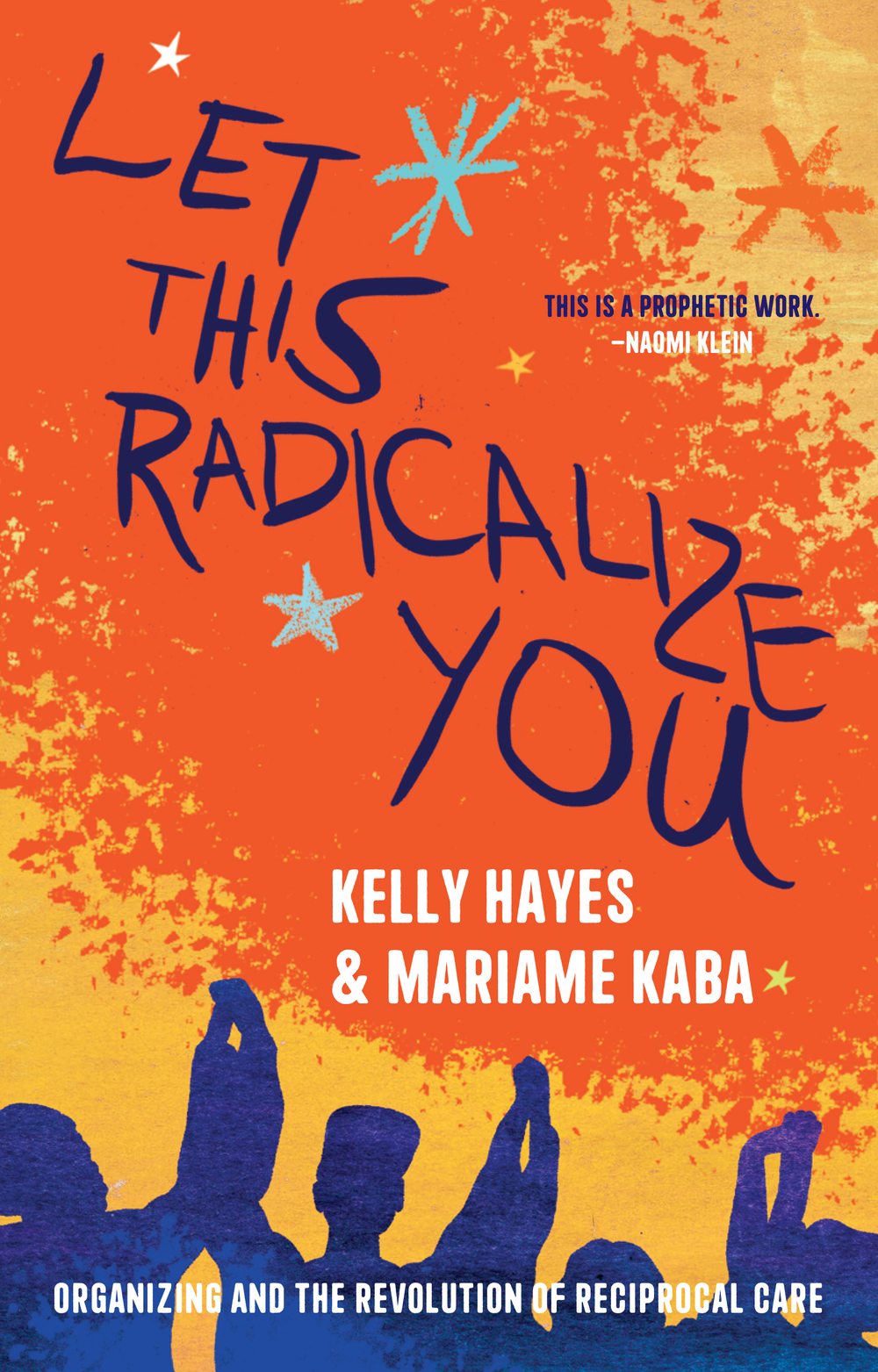
2) Let This Radicalize You by Kelly Hayes and Mariame Kaba: practical advice for organizing and activism, and how to make hope something that you build with others.

3) Maybe I’m cheating by calling this one a single resource, but it’s just too good! Interrupting Criminalization has got so much! Use it all, share it all! They are amazing!

4) Shaun does amazing work speaking to and about young white men from a critical but also humanizing perspective. Here’s another of his videos, and more resources I’ve compiled for fostering positive masculinity.

5) This one is a bit of a spicier recommendation, but if you’re ready to go even deeper and see how spirituality is an essential component we need to integrate in order to combat the appeal of fundamentalist cults, then listen to The Emerald podcast. “Oh Justice” is a relevant episode, but listen to any that pique your interest. My favourite is “Snail Juice.”

Be well, keep up the good work, rest and find joy. I love you, we’re all in this together.

Hi, I quit academia to educate without gatekeeping. It makes me very little money, but if I get enough supporters, I can do it full time. If you appreciate this article, please share it with others! Here are three ways to say thank you, and support me doing more of it:

❤️ Join my Patreon 

💲 Send me some cash I can use to pay rent

👧 Buy my kids supplies like toothpaste and sunscreen!

Dr. Hilary Agro is an anthropologist, community organizer and mother of two young children.

Can you be a parent and an activist?

I am consumed by a difficult realization I’ve come to lately.

The care my children need to be as protected as possible under the conditions of capitalism outstrips my ability to provide it while also doing activism.

It’s hard to admit, but I didn’t put very much thought, before having kids, into how much doing so might take away from the activism that’s been the bedrock of my life for over a decade. Attempting to maintain the same level of productivity in my work and organizing while parenting two small children has so impacted my physical and mental health that I believe I have finally, just recently, hit extreme burnout.

My body aches at all times. My hips are in pain, possibly due to the double C-section scar that I have not given myself the time to properly heal, because who has time for that when there’s an overdose crisis and people are dying? My teeth grind at night, possibly because I have not let myself access the amount of rest I’d need to relax my body, because who has time for that when there are multiple genocides happening? The pain in my back starts at a 4 every morning and ramps up to an 8 by the end of the day, because who has time to do yoga when the oceans are acidifying and the forests are burning and leftists can’t stop angrily venting their trauma at their fellow working-class people for long enough to build a movement that can turn this ship around?

I turn this physical pain into empathy, by thinking about the parents and other workers who secretly use opioids to deal with the pain thrust upon them by the demands of capitalist (re)production. I finally get, on an embodied level, why they do it. I wish more people would understand that drug use is a rational response to a violent society, because if they did, we might stop throwing people who use drugs in prison and taking away their children. My pain turns into wisdom, and I feel compelled to share this wisdom with others, so I do. It feels so urgent. A more pressing demand than taking twenty minutes out of my day to massage my C-section scar and do physiotherapy for my diastasis recti. So the pain lingers in my body, like a poison made of urgency, of the screams of dying Palestinians and old growth forests.

I do not believe that parenting on its own is enough of a contribution to building a better world, as many people say it is. Just “raising the next generation with good values” is not enough when our land, air and water are under such dire, immediate threat that by the time my children are adults, they may not have anything left to survive with. The problems are too urgent for parents to do nothing but raise our children well. But how much labour is enough?

I made my decision to have kids before knowing that a dangerous virus would be threatening us for years on end. Before knowing how little I would be able to rely on the Canadian medical system, or any other system, or even my own community members, to protect us. I feel naive, but I see people still making the (to me, at the moment, somewhat baffling) decision to have children, so it would seem that either the gravity of the threats facing children right now are not actully as severe as they seem to be from my ostensibly well-informed perspective, or most people, even leftists, are in denial about the dangers and the weight of responsibility that comes with bringing children into the current world. Or perhaps, as a neurodivergent person in trauma recovery whose disabilities did not become so acutely obvious and pressing until after I had kids, I am simply far less equipped than most people to handle the stresses of parenting. But I’m not sure I’m so unique, as our society is disabling and trauma-creating on a scale wider than most people realize.

To keep my kids truly safe, I would need to join their school’s PTA and devote all my time to ensuring quality air filtration in their classrooms. I would need to spend the few spoons I have on teaching them to wear masks in indoor public spaces and convincing them to keep doing it, every day, even when it’s uncomfortable, even when no one else is doing it.

I would need to teach them how to garden, to build their connection to the land so they become naturalized citizens of this place, and learn to care for the land that cares for us, as well as survival skills for what may come.

I would need to prepare weekly activities that make them into good neighbours and citizens. Writing thank-you cards, preparing gifts for their friends, baking cookies to bring to parties.

I would need to expose them to Mother Earth, creatively teach them to understand and love trees so their ability to see and appreciate nature doesn’t wither under the ten-tonne weight of the cartoons and superheroes vying for their attention and filling their brains with cravings for plastic toys and refined sugar.

I have been doing some of this already. But the parts I’m able to do are already more than I have the capacity for. So where, in all of this, is there time to organize my community? How can I attend socialist meetings with an energetic three-year-old? How much of my limited supply of energy can I give to exposing myself to enough information about the various ongoing genocides that I am able to take action to stop them, without becoming incapacitated for the evening when my third labour shift of the day starts? How can I do all of this while also finishing my PhD, taking care of my relationships, and maintaining my physical and emotional health?

These are questions I have been struggling with, with no good answers. I am not currently striking a balance. Maybe when they’re older, I can more easily involve them in organizing activities. Does that mean that while they’re 3 and 5, I can take a full break from all of it? When do I start up again? Which aspects of my caregiving or my community organizing can I sacrifice?

Caring for two small children on my own, which I often do these days, means the built-in stress levels of my day-to-day are high. It requires large amounts of patience, recovery time, and practicing emotional regulation skills to parent with only sporadic community and family support. It’s easy to say “cook with your kids,” it’s harder to put that task into practice when half of your time and attention is spent intervening in messes, breaking up fights, rushing a toddler to the bathroom, and attempting to give two children 100% of your attention when at most they can each have 50%. In the evening, you have to try to do all of this while you’re already exhausted from a full day of labour, and facing down another endless bedtime (my 3-year-old Mila does not, and seemingly cannot, fall asleep until 10 pm).

And all the while, underneath, there is the gnawing tension of the knowledge that good participatory habits must be fostered early—if you wait until your kids are old enough that they’re better able to stir soup without spilling it or carry a carton of eggs without dropping it, by then they won’t want to cook with you at all, because the early flames of their desire to will have died out, tamped down by their cargivers’ exhausted impatience and redirected towards toys and screens.

Children can sense the neglect inherent to the nuclear family arrangement, and it upsets them. They need so much more than one or two caregivers can provide. My 5-year-old Eva is increasingly frustrated with my inability to read to her for as long as she would like because of the demands and interruptions of her younger sister. Meanwhile, Mila is the most extroverted human being I have ever met (you think I’m exaggerating, but I’m not) and is the easiest kid in the world if many people are around for her to interact with, but if you’re on your own with her, you do not get a break. I don’t have the energy or time for much creative play because I’m so busy meeting their basic needs and teaching them functional skills, and most of the time there are no other kids around to meet their very high need for play. It’s wonderful when they play with each other, but more often than not it ends in tears and rage as I cannot supervise closely enough to make sure Mila doesn’t grab Eva’s toys while I’m making their breakfast. Humans were not meant to live in isolation like this. It’s simply not possible to give children everything they need under these circumstances, and that’s without adding the extra pressure to stave off environmental collapse.

I do have friends who help me out, and they are lifesavers. The tiniest act—playing with my kids, washing a few dishes—fills me with overwhelming gratitude. I have especially noticed that my comrades who are the most accomodating and helpful are the ones who are the most embedded in liberationist politics, which is beautiful and, I suppose, unsurprising. The ways in which liberation-minded people are trying to live our values and build the communities we want to see gives me hope (though it also comes with complicated feelings—I cried with equal parts relief and deep guilt when my Palestinian friend offered to come vacuum my apartment when my vaccum broke, at a time when her people were and are being genocided). But these are also friends I’ve made largely through my activism—what happens if I give that up for several months, or a year, or two? Will they still show up for me if I’m burnt out and unable to reciprocate any community work? I need so much because my children need so much, and there’s so little I can offer in return right now. How much can I rely on my already overworked and burnt out friends, most of whom are BIPOC, queer, and/or disabled?

I can see, like I’m Neo at the end of the Matrix, exactly how all of these pressures create the desire to make more money. Money can solve many (though not all) of these problems, so buckling down and focusing on securing income for your own family feels like the only option. And once you do that, you’re hooked—the desire to make money in order to feel safe and afford the supports you need becomes its own self-sustaining capitalist illness. There but for the grace of my own neurodivergent stubbornness, and years of exposure to anarcho-communist principles and Indigenous ontologies, go I.

What to do, then? My bones are creaking. My mind is consumed with grief for the state of our world. It’s too much. I have recently decided to take a medical leave from my PhD to focus on getting my health back in order. I’ll be putting a pause on most of my activism as well, which will be the hardest part. But something has to change. I love myself, my kids and my comrades too much to not try to find balance. I cannot tell others that this is a marathon not a sprint, take care of yourself and all that, and not follow my own advice. I am going to reset, spend time with trees, and figure out what a sustainable work/life/activism balance looks like for me now.

Most parents in your community don’t have the ability to do this. They are drowning.

I know that many people, given how empathetic and kind my audience generally is, will want to soothe and reassure me that I’m doing the best I can. You may want to offer tips to improve my situation. I do appreciate and welcome this, but what would truly make me feel better would be if you commit to helping your comrades who have children, and talk about it publicly. You really can’t imagine how much stress they’re under. We have so normalized the idea that parenting is naturally exhausting, many parents don’t even realize that they should not have to suffer like this. Child care is mutual aid, and one of its most neglected and essential forms. I would probably cite Silvia Federici or Sophie Lewis here if any of their books existed on audiobook so I could read them, lol.

So, what can you do? Here are some suggestions:

  • It’s hard to get kids out the door to go to things, so go visit your friends with kids. Ask what help they need, and if they’re unsure, the kitchen or bathroom is a great place to start. Bring food.
  • The best thing for the whole family is playing with the kids themselves, as you can give parents a break while simultaneously providing something that kids badly need, which is socialization with people beyond their primary caregivers.
  • Many of us parents fall into the instinct to zone out on our phones when we get a second of reprieve. If you’re offering to take care of the kids for a bit, gently ask your friend to think about what they might want to use that time for. If it’s zoning out on their phone, that’s fine, but just a little orienting question to help them be intentional about it will help, and it may make them more likely to do something more restorative with their time.
  • Offer not only to go on outings with your friends and their kids, but offer to meet them at their place first to help get the kids out the door.
  • Hang out with your parent friends while they’re in the park so you can chat while they kids run around the playground. Host gatherings in kid-friendly spaces.
  • Talk to others in your leftist organization(s) about accomodations for parents. Can you provide engaged child care at meetings? Can you help parents get to meetings? If your group is small, can you commit to meeting at the homes of people with kids, if they’d prefer that? Can you bring snacks/food to family-friendly actions, and state that on social media so parents know they don’t have to do the added labour of packing snacks?
  • Wear masks in indoor public settings. Fight for better air filtration in these same settings, or bring your own air filters to events/gatherings. Open all the windows.

Thank you, beloveds, for reading all of this, and for thinking about what I’ve offered here. Please share this post on social media so it can start discussions about these issues. Do you have similar experiences or insights to share? Am I the only one going through this?

One thing, though–note that if your instinct when you share this is to talk about how all of this is why you decided not to have kids, that’s fine, but please temper it with a stated commitment to helping other peoples’ children survive, as it can otherwise come off as dismissing these common concerns as the fault of individual parents’ decisions to have kids, when doing so is the most normal impulse in existence and shouldn’t be shamed. If we want to build a better world, we need to support parents, as they are the primary caretakers of the next generation that will help us survive in old age, and will pass on our teachings. More than anything, because children deserve so much more love and care than they are being given under the current conditions. You do too. We all do.

Hilary Agro is a community organizer, low-income PhD student & mother of two young children. If you appreciate the labour that went into this article, consider sending me and my kids some masks, HEPA filters, diapers or books, or just a cash tip

How can we save ourselves?

I’m an anthropologist doing my PhD on activism and organizing. I’ve also been an organizer myself for over a decade, primarily focusing on drug policy, but also coalition-building between different groups of people impacted by capitalism (aka, the entire working class). Right now, more than I’ve ever seen in my lifetime, people are ready for change and hungry to take action. So my goal is to facilitate transferring knowledge and experience from seasoned activists to newer ones, so people don’t have to learn lessons the hard way, and we can be as effective as possible in transitioning to a world that isn’t shitty. So here’s what I’ve found so far about what actually works, and what doesn’t.

What works:

“Hope doesn’t preclude feeling sadness or frustration or anger or any other emotion that makes total sense. Hope isn’t an emotion, you know? Hope is not optimism. Hope is a discipline… we have to practice it every single day.” — Mariame Kaba
  • Building community by making people feel welcome. This is the first and most important step. People won’t trust you if they think you don’t care about them or aren’t actually listening to their needs. Prove to them you care about them first, and create spaces where they feel welcomed, included, listened to and valued.
    • “[A woman in the group] really started to encourage me and welcome me, like, ‘hey, you’re good at this, you understand what you’re talking about and have passion. Would you consider joining the board and being more involved?'” – a Canadian activist I interviewed on why she got involved with a group
  • Leveraging labour power – it’s all we’ve got. Unionize and strike.
  • Targeted, specific, strategic goals.
  • Creating coalitions based on bonds of trust and support.
  • Balancing learning with praxis.
  • Understanding intersectionality.
  • Seeing all struggles as interconnected.
  • Being kind to people and hard on systems. (E.g., it’s not “men” that are the problem, it’s patriarchal masculinity. People can and do break free of the systems & programming that are causing them to harm others.)
  • Practicing hope as a discipline. It’s an action, it’s something you practice, not a feeling.

What doesn’t often work:

  • Using shame (especially on working class people) – I can’t stress this one enough. You were disciplined using shame in your childhood – how did that make you feel? How do you wish you were treated instead? Probably with patience, kindness, love and clear boundaries. Start treating others, and yourself, that way.
  • Begging politicians – they don’t care. They only respond to leverage.
  • Spending all your time reading theory.
  • Arguing with strangers online.
  • Dehumanizing others (including people who you disagree with, even people who dehumanize you. This is very hard, but it’s essential).
  • Playing oppression olympics rather than looking for the overlaps in our struggles.
  • Nihilism, especially when you tell others there’s nothing we can do – every time you do that, Jeff Bezos smiles and pours himself another glass of adrenochrome.
  • Relying on saviours, politicians, or anyone with power.

This is not a complete list by any means, just a bit of what’s come out of my own organizing experience and my research (working with & interviewing dozens of seasoned activists). I’m (agonizingly, painstakingly) writing a whole dissertation about it, but I want to start posting tidbits like this on my blog like I used to!

Feel free to leave a comment and discuss with your friends and comrades, and remember:

  • We’re in this together, and we’re all we have. Be kind.
  • Focus on what actually works, not what you wish worked. Interrogate whether an approach is based in hate and catharsis, or love and care with a clear-minded appraisal of a situation. What evidence do you have that a certain tactic is effective? What else could be tried? What feels good in your body to do?

For more information and resources, poke around this list! Or just go straight for the best resource by reading the book Let This Radicalize You by Mariame Kaba and Kelly Hayes.

The work I do to put together resources like this and organize in my community takes a lot of time and energy, and I do it for free in my limited spare time as a grad student and mother of two small children. If you are grateful for my work and want to support me making more of it, your help is deeply appreciated and will go to feeding myself and my two little kids:

💲 Send money on PayPal
🍼 Send my baby some diapers (or me some books)
❤️ Support me on Patreon

I love you. Stay strong. Act always from care, not hate. Spend your energy wisely. Model the world you want to see ❤️

Community organizers were arrested for providing a safe supply. They need our solidarity.

Skip to the action steps

You know how we’ve been fighting to legalize and regulate drugs, so people have access to a safe supply? Well, two community organizers in Vancouver got tired of watching their friends die from the poisoned supply, so they went ahead and created their own safe supply organization, the Drug User Liberation Front (DULF), to give away free, pure, tested drugs to people who need them. This is the kind of direct action civil disobedience we need more of! DULF has been running for over a year with few problems. It has saved countless lives, and is a crucial living demonstration of the possibilities of community care and self-sustenance.

However, after right-wing backlash this summer (Poilievre and the National Post have been relentlessly attacking harm reduction so they can scapegoat drug users and blame them for the effects of the housing crisis, as capitalists always do when their profiteering wreaks havoc), this week two co-organizers at DULF, Eris and Jeremy, were arrested. Solidarity protests are being organized around the country right now. This is an injustice!

Supporting and protecting activists and organizers is essential for dismantling capitalism. As we fight for a better world, we need to ensure that the people taking risks to create alternative infrastructures and divest from carcerality and capitalist modes of production are protected, supported and loved. Stand in solidarity with these brave community organizers!

More information is available here. Action steps below.

Action Steps: