[Hi. I’m back. I’m digressing from my usual topics to get a little cathartic and personal for a bit. Don’t worry, for the next post we’ll be back to the drug stuff.]
Reading.
Reading used to be fun.
Back when everything I read was by choice, I could curate my own reading lists that reflected the kind of narratives that kept me going, kept me hungering for more. They fed my imagination and honed my scattered brain into the hyperfocused reverse of itself.
Reading was delightful, relaxing, rewarding.
Now, reading is torture.
It’s the enemy I face off every day. Trying to wrangle sentences from social theorists into submission is the constant state of my being.
I hear my colleagues say it took them an hour to read an article that it took me an hour to get six pages into and I want to cry.
Should I be here?
Is this where I belong?
I pop another Dexedrine and stare at the orange bottle: the key that unlocked the door to academia for someone who by all rights, shouldn’t be here. This space is not built for me. It is hostile to the way my body and mind function. I should have dropped out years ago. I almost did, twice—once in high school and once in undergrad—before the fateful ‘diagnosis’ that turned my C’s into A+’s and miraculously gave me the ability to pursue my dream.
I wouldn’t be here, but for this little orange bottle. It contains my freedom. It’s my crutch.

Academic writing seems designed to keep people like me out. Its dialect is a barrier constructed to exclude those who don’t have the socioeconomic, cultural and linguistic capital to penetrate it. Whose minds have resisted all attempts, external and internal, to be moulded into a narrowly specific way of absorbing knowledge. Read this, we are told. The onus is on us to figure out how. We are at a disadvantage from literally page one.
It smells like bullshit, like there’s something not quite fair happening. But it feels like personal failure.
Sometimes I think maybe grad school is secretly just an insane don’t-ask-don’t-tell circus. Surely no one actually does all the readings? It seems impossible. I can’t make my brain slow down enough to grasp the words on these pages when they’re so incredibly dense and meandering and nonspecific and abstract. If there’s no narrative, no examples, no stories—I can’t follow it. I physically try to force myself, and I fail over and over again.
Then, the depression sets in. The self-loathing.
My relationship to the concept of disability is ambivalent. I certainly feel disabled when I’m trying to read, but identifying as such given all my objective advantages feels like appropriation somehow. I wish I had some sort of sociopolitical solidarity to rally around to argue why Western academic social science writing is exclusionary to people like me despite the fact that I was shaped entirely within it, the way it clearly is to people from other cultures and backgrounds and epistemologies. I am cis and white and middle-class, I am ostensibly who academia was designed for. This place is supposed to feel like second nature to me, I am told. But my type of people—those of us with reading disabilities, ADHD, or just those who process differently—can’t absorb information in the way everyone else around us seems to be able to. But I don’t know who my people are. I don’t know who else to rally to solidarity. We are invisible. We are weeded out early. We are not common in this line of work by default. All I have is a diagnosis that I don’t even fully subscribe to, but whose necessity becomes starkly clear whenever I stop taking the meds. But how can you medicalize a way of thinking and call it a ‘disorder’? I am not disordered. This pedagogy is disordered.
When an otherwise functional, stable, intelligent person has to be medicated to succeed within a system, there’s something wrong with the system.
Hello Foucault. It’s nice to meet you, I’ve heard so many wonderful things. I like your glasses, and also your scathing indictment of modern carceral systems. Listen, I have some questions for you. If your ideas are so necessary, so revolutionary, why are they so difficult for us, the intellectual proletariat, to grasp through your writing? Why are you getting away with helping to perpetuate the very structures of exclusion and power that you rail against? You are complicit in their maintenance and silent about that irony. Explain yourself.
I keep hearing people say, “oh, it’s worth it once you slog through [X impenetrable author] for the brilliance.” And yes, I have found that to be the case for some authors. But look, some of us just don’t have the fucking time. I’m not saying I’m too busy doing other things. I’m a student, this is my job. All I do is read, and I try very hard to slog through these authors every single day. I’m saying I literally cannot physically read fast enough in a given allotted time to properly digest an entire book by those impenetrable authors. Or even most of it. Or half. The time-spent-to-intellectual-benefit ratio is completely skewed for this type of dense, convoluted writing. I can learn so much more from a podcast or documentary or narrative ethnography about a similar topic. Hell, in terms of time spent relative to benefits, I’ve absorbed a lot more from following Black, Indigenous and decolonial feminist anthropologists on Twitter than from trying and failing to read Donna Haraway.
So yeah. Maybe academia isn’t for me.
Except… I’m here somehow. They let me into a top-tier anthropology PhD program with full funding. I have a Master’s degree; I’ve been told my thesis was good, very good even. I’ve made it here despite ignoring all the Big-Cheese Social Theorists and relying entirely on the little guys, the Comprehensibles, the ones I can and do read, who mix theory in with stories–Bourgois, Agar, Moore, Singer, Garcia. What does it mean? Am I a fraud or are all those French sociologists frauds?
I’ve swum around them, these giant mysterious intellectual whales in a sea of friendly little ethnographer fish. Most of the fish know the whales’ songs, and at their register I can actually hear them. So fuck the whales, I think. I don’t need them. I’m a product of the Internet age. Wikipedia and YouTube have been my shortcuts through a world of writing I can’t penetrate to crack open the sweet sticky centre of the ideas inside that writing, which in the end are all that matter. All along, there’s an uneasy feeling I can’t shake that this isn’t right, that I’m missing something, that I’m cheating. That my inabilities, my disability, my patched-together and selective reading history will catch up with me someday. That I’ll be exposed for the illiterate goon I am and unceremoniously booted out of this discipline I love so much.
And yet, somehow, I seem to get by. I get good grades, I’ve been told that I express my ideas coherently in classes and am an above-average public speaker, even if I don’t quite believe it. People regularly tell me they like my work and my public outreach (blog posts and Twitter) has been very rewarding. I love everything else about grad school and about anthropology–research, teaching, listening, learning, thinking, experiencing. The stuff I can read, I am absolutely fascinated by. I’ve gotten funding and scholarships–I am being given money to think and write about stuff. I feel like I have things to say, a perspective that would benefit from being heard in my discipline. I have concrete things to point to when I’m feeling particularly useless.
But none of this makes me feel any better when I’m staring at words swimming on a page. Instead I walk endlessly back and forth on a scale between self-hatred and bitter rage at the people I’m reading.
Right now, for example, I need to write a response paper about a very famous book by a very famous man named Bruno Latour. I don’t understand the first fucking paragraph and that fact is all I want to talk about:
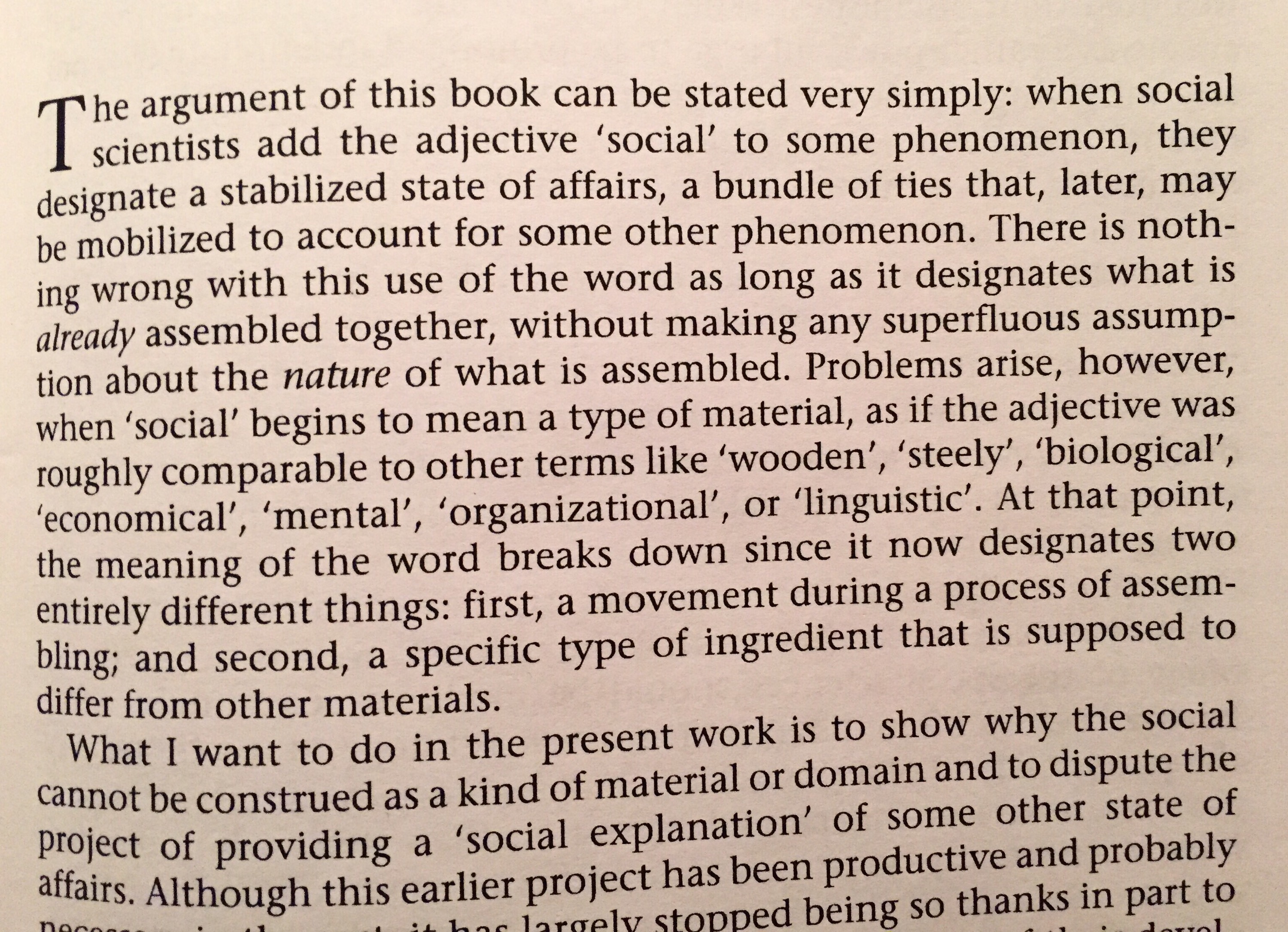
…For real? Is this a joke? Are we really all just gonna pretend that this kind of writing is an ACCEPTABLE WAY TO COMMUNICATE?
My internal thought process while reading goes something like this:
Okay, stating something simply, I like it, what’s next… Okay so I had to read the next couple sentences five times each because my brain kept showing me pictures of antique boats and my dad when he had a moustache and what I had for breakfast and Jon Stewart dressed as Donald Trump all set to the tune of that Talib Kweli song I can’t get out of my head mixed with the humming from my computer, but eventually I got there… Wait, hang on now. Slow down there compadre. What do you mean by ‘material’? You haven’t quite defined that and the way you seem to be using it in a way is diverging from my own understanding of the potential uses of that word and so I’m already lost. No, don’t try to blame the translator. I’m going through the repertoire of what you might mean by ‘material’ and nothing seems to quite make it work. I am also not familiar with a world in which the word ‘social’ can be productively equated with the word ‘wooden’ or ‘steely.’ It is not because I lack imagination. It is because you lack communication skills. Am I supposed to just buy this and move on? Why should I let you get away with this shit? Convince me. I am a skeptic. You are not winning me over with this attitude. …Or maybe I really am not cut out for this. I don’t know. Why can’t I remember more than the first two lines of this Talib Kweli song? Back to Latour. Focus. Wait, now it’s a ‘movement’? When did that happen? ‘Ingredient’? What? WHAT ARE YOU TALKING ABOUT?! I hear your ideas are important, what are they?! Give me your secrets, Latour! I want to understand! TALIB WILL YOU PLEASE LEAVE ME ALONE FOR FIVE MINUTES I’M TRYING TO CONCENTRATE!
Yeah. That’s paragraph one.
I’m supposed to read 140 pages.
I don’t know. Maybe I really don’t belong here. Or maybe you can get a PhD with Google and reflexive feminist ethnography and theory-by-proxy. Maybe the calls for valuing clear, jargon-free writing in academia will become something more than lip service in time to save me. Maybe all those intelligible, narrative-oriented authors I can actually read are on the rise, and they will revolt and overthrow the opaque obfuscatocracy and take over, freeing us lowly idiots from our intellectual subjugation. My supervisor is one of those legible authors, that’s for damn sure. She knows how to write. I devoured her book in three days because she has enough respect for her audience to tell a story while she analyses. Why isn’t she the head of [whatever fancy French program somewhere that Latour sits on top of in a building that will be named after him someday, drinking wine and laughing at us peasants with brain disorders as we struggle to comprehend his revered words]?
Sigh.
What can I do? I’m far too obsessive and determined to just convince myself that I don’t need the big whales at all. If I haven’t given up now, it’s not going to happen.
So. I put on some Talib Kweli, drink some water, and steel myself. On to paragraph two.
Note: I receive more emails and messages about this post than all my other writing combined. I love hearing from other students who relate to this experience! It’s clearly a systemic problem. However, if you message me and I don’t reply, I’m sorry, I get overwhelmed–and now that I’m a full-time mom AND PhD student, my ability to respond to messages has been all but wiped out. But please know that I hear you and value you. You aren’t alone. You are amazing for getting as far as you have. Believe me when I say this: it’s not you, it’s them. ❤
If you like my writing, please consider supporting me on Patreon, or sending some diapers for my baby from my Amazon list 🙂 I’m a low-income grad student and new mom trying to fight against the devastation of the Drug War–every little bit helps.
Find me on Twitter ranting about drug policy, criminal justice reform, anti-capitalism, psychedelics and anthropology: @HilaryAgro


 Dr. Hilary Agro, PhD